Process Development
Process optimization for plasmids from development through scale-up
We provide comprehensive gene therapy process development services to help transition your research-grade process into a scalable, cGMP-compliant manufacturing process for cell and gene therapy. Over the past two decades, gene therapy research and development have advanced significantly. The biopharma industry faces an increasing demand for viral vectors in cell and gene therapy, with heightened expectations for higher quality, improved manufacturing processes, higher titers, and greater yields.
To meet these challenges, Andelyn’s process development scientists focus on creating cost-effective, robust, and scalable platforms that support both clinical and commercial applications. By integrating quality-by-design (QbD) principles, we help accelerate timelines, optimize costs, and ensure reliable manufacturing processes from early-stage development to large-scale production, with particular emphasis on viral vector process development and AAV process development.
Our team remains at the forefront of innovation, continually evaluating emerging technologies and developing new strategies to improve production, purification, and product quality. Collaborating closely with the analytical development group, we implement orthogonal analytical methods to ensure comprehensive product characterization at every step of the gene therapy process development lifecycle, avoiding reliance on a single technique. This includes assays for vector genome titer, infectious titer, purity, potency, residuals, empty/full capsid analysis, identity, and stability to support biomanufacturing process development and consistent quality control.
This commitment to excellence empowers us to deliver tailored, scalable solutions that advance the field of cell and gene therapy while meeting the demands of both early-stage and large-scale programs. Through end-to-end viral vector process development and AAV process development, we design upstream, downstream, and formulation phases that integrate risk assessments, critical quality attribute (CQA) definition, and control strategies to ensure reliable outcomes in biomanufacturing process development.
Process Optimization for Suspension and Adherent Systems
- Use scale-down models for efficient production processes aligned to gene therapy process development.
- Optimize yield/recovery, capsid separation, and CQA during viral vector process development.
- Ensure reproducibility, scalability, and smooth transfer to cGMP manufacturing within biomanufacturing process development.
Critical factors for optimization

- Enhance cell culture with better cellular factors
- Refine media factors for long-term scalability
- Optimize transfection reagents and DNA factors
- Improve harvest factors for better recovery and process performance

- Purify raw materials with clarification factors
- Ultrafiltration/diafiltration for purity and efficiency
- Refine chromatography using specialized column chemistries
- Use ultracentrifugation for precise viral vector production as part of AAV process development

- Create stable products with optimized buffer factors
- Develop fill/finish parameters within biomanufacturing process development
Our Approach
Data-driven process optimization leveraging decades of production data to minimize the number of process parameters and conditions that need to be assessed, ensuring cost-effective and improved manufacturing for clinical and commercial success. This approach unifies viral vector process development, AAV process development, and broader biomanufacturing process development into a cohesive, phase-appropriate roadmap.
Enabling Your Program
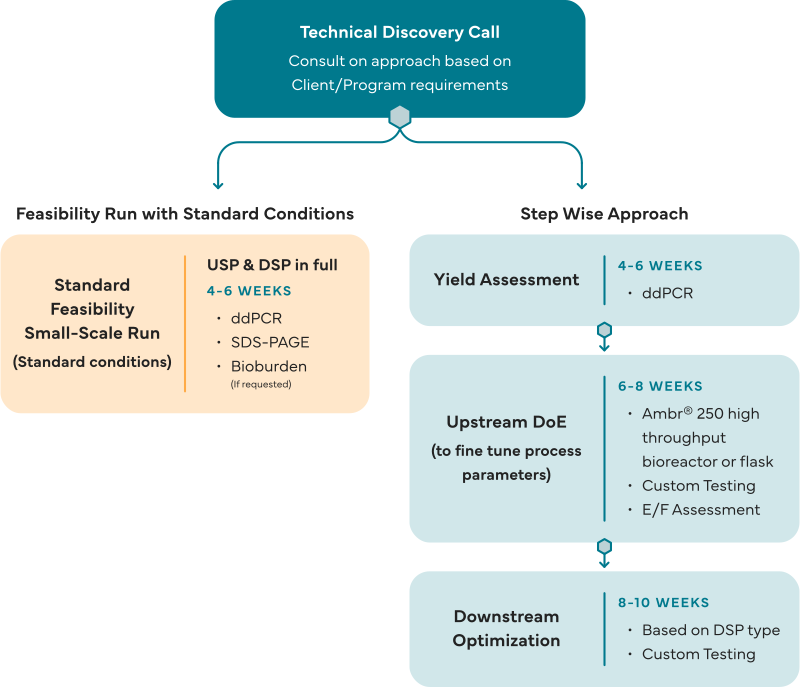
Andelyn Feasibility Study
Andelyn's small-scale feasibility studies enable you to generate data that drive decisions and help draft your manufacturing roadmap from GMP to commercial scale. These studies de-risk gene therapy process development and accelerate viral vector process development in preparation for AAV process development and full biomanufacturing process development.
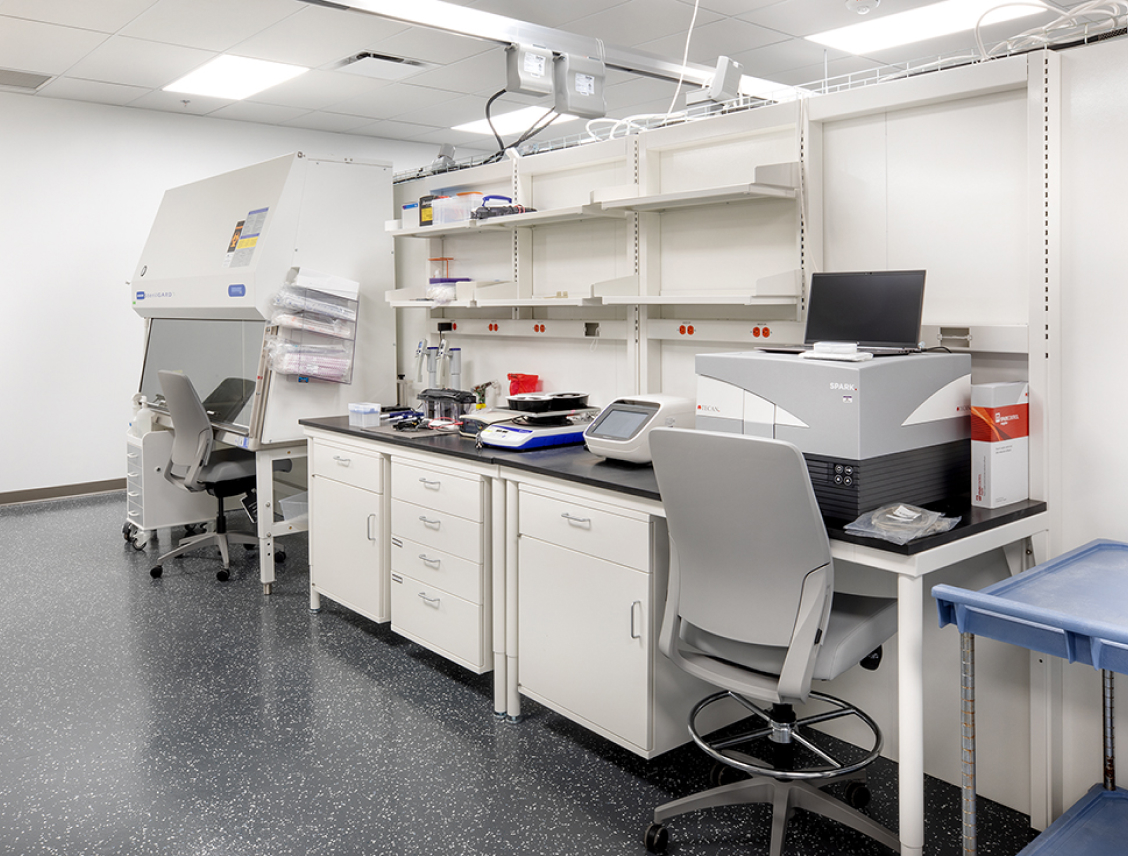
Andelyn Development Center
Explore the heart of innovation at the Andelyn Development Center (ADC), where groundbreaking research, meticulous process development, and advanced analytical capabilities converge. As the cornerstone of Andelyn’s capabilities, ADC expands horizons and meets the evolving demands of our clients while supporting end-to-end gene therapy process development.
Seamless Transition to cGMP Manufacturing
Once your process is optimized, Andelyn's seamless transition to cGMP manufacturing ensures consistent quality and efficient scale-up. Our state-of-the-art facilities and experienced team maintain the integrity of your process while meeting the highest regulatory standards within biomanufacturing process development.
Rigorous Analytical Testing Throughout Development
Our comprehensive suite of analytical services is embedded within your process development journey. This ensures continuous monitoring, characterization, and quality control allowing for informed decision-making at every stage of viral vector process development and AAV process development.
Frequently Asked Questions
What are the main steps in gene therapy process development?

Typical steps include defining the target product profile and CQAs; establishing and using scale-down models for upstream optimization (cell line and system selection, media, transfection/infection, and harvest) and downstream optimization (clarification, chromatography, ultrafiltration/diafiltration, and ultracentrifugation); formulation and stability; and technology transfer to GMP. We execute these phases within a structured viral vector process development plan and refine them through AAV process development, when applicable.
How is a gene therapy manufacturing process designed?
We apply QbD principles and use a multifactorial DoE strategy to optimize parameters that maximize productivity, quality, step recoveries, and scalability during process development; map critical process parameters (CPPs) to CQAs; develop robust control strategies; and lock in scalable unit operations. This design integrates analytics, risk assessments, and comparability to ensure seamless biomanufacturing process development and predictable performance from pilot to commercial scale.
What analytical methods are used during gene therapy process development?
Orthogonal methods include vector genome quantification (qPCR/dPCR), infectious titer assays, capsid content (AUC, Mass Photometry), impurity profiling (host cell DNA/protein, residuals), purity (SDS-PAGE, SciEx), potency assays, identity (sequencing), and stability/aggregation (DLS, SDS-PAGE, ELISA). We integrate these methods throughout viral vector and AAV process development to inform decisions.
How do developers ensure quality control in gene therapy production?
We establish in-process controls, reference standards, and release tests aligned with CQAs; employ in-process monitoring of CPPs at all scales; review Master Batch records (MBRs) and provide training for process steps; and conduct comparability and robustness studies. Data trending, deviation management, and phase-appropriate specifications underpin biomanufacturing process development and cGMP readiness. We perform process characterization to establish NORs and PARs that control CPPs for each product, ensuring PPQ readiness.
What are common challenges in scaling up gene therapy processes?
Key hurdles include maintaining productivity across scales, managing shear and mass transfer, preserving empty/full ratios, controlling impurities and residuals, ensuring the supply of critical raw materials, and facilitating technology transfer across platforms and sites. Systematic gene therapy process development and targeted AAV process development mitigate these risks through proven scale-down models and defined CPP ranges. Another challenge is the emergence of recombinant serotypes, which may not reflect the properties of the parent AAV from which they were derived; these may require process changes and specific experience to address.