Gene Therapy CDMO Selection for Speed and Scalability
How to Assess a Manufacturing Partner for Speed, Quality, Scalability, and Commercial Readiness
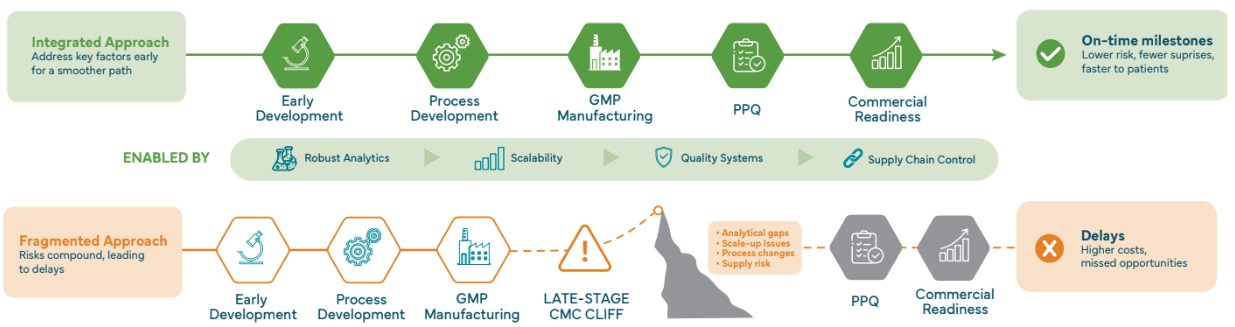
Choosing a contract development and manufacturing organization (CDMO) for a gene therapy program is a strategic decision that influences timelines, regulatory progress, and commercial outcomes. Because product attributes are tightly linked to how adeno-associated virus (AAV) and lentiviral vector (LVV) therapies are made, gaps in process understanding can surface late and slow progress. Avoiding the late-stage Chemistry, Manufacturing, and Control (CMC) cliff requires a partner with platform expertise, integrated quality systems, robust analytics, and supply chain control. Effective gene therapy CDMO selection hinges on aligning program goals with proven execution, while ensuring CDMO analytical services for gene therapy are established early and consistently applied.
What to Consider When Selecting a Gene Therapy CDMO
Key factors include technical depth across upstream and downstream operations, analytical readiness, raw material management, scalability, and a transparent operating model. Evaluate whether the CDMO offers integrated services (plasmids, process development, analytics, GMP manufacturing) to reduce handoffs and documentation risk. Confirm capacity planning and governance structures that provide clear visibility, milestone tracking, and timely decision-making. In practical gene therapy CDMO selection, also assess CDMO capabilities for cell and gene therapy that span development through GMP manufacturing, and confirm AAV CDMO selection criteria such as platform robustness and assay maturity.
How CDMOs Differ in Viral Vector Production
CDMOs vary in their platform strength, production modes (adherent vs. suspension), producer cell line expertise, capsid enrichment strategies, and ability to maintain equipment parity from development to GMP. For AAV, management of empty/partial capsids and scalable purification is crucial. For LVV, vector stability, transduction consistency, and the impact of scale on performance are central. The strongest providers combine configurable platforms with sound technical judgment and standardize where it speeds progress and customize where the product demands it. These differences should align with your AAV CDMO selection criteria and with the broader CDMO capabilities for cell and gene therapy needed for late-stage execution.
Questions to Ask About Regulatory and Analytical Support
- What has your GMP batch success rate been over the last 24 months?
- Do you maintain equipment and process parity from development to GMP?
- Which critical assays (e.g., vector genome titer, full-to-empty ratios, potency) are already established or qualified for my modality?
- How do you approach capsid enrichment and product quality control at scale?
- How are raw materials classified, qualified, and controlled across the lifecycle?
- What is your audit and submission support track record for late-stage programs?
Ensure CDMO analytical services for gene therapy include phase-appropriate methods, qualification plans, and comparability strategies that align with regulators.
The Importance of GMP Manufacturing Experience
GMP experience is essential for late-stage readiness. It signals mature quality systems, data integrity, validated facilities, and inspection preparedness. Experienced CDMOs can anticipate comparability requirements, integrate Quality by Design early, and align analytics with each development phase. Consistent GMP execution reduces deviations, accelerates release, and supports smoother transitions to PPQ and commercial supply. In gene therapy CDMO selection, proven PPQ readiness and inspection history should be core decision drivers.
Raw Materials and Supply Chain Discipline
Plasmid DNA, media, transfection reagents, resins, filters, and single-use assemblies support process consistency and product quality. A strong CDMO will identify critical materials, qualify suppliers, conduct incoming testing for higher-risk materials, and enforce a lifecycle approach. In-house plasmid capabilities can reduce handoff risk and improve schedule management. Ask about the forecasted lead time and the securing of materials for pivotal studies and launch. These controls are essential CDMO capabilities for cell and gene therapy and are key factors in AAV CDMO selection.
Common Risks When Partnering with a CDMO
- Analytical gaps that delay INDs, PPQ, BLA, or licensure.
- Scale-up limitations that force late process changes.
- Fragmented vendor models that complicate tech transfer and documentation.
- Supply chain shortfalls, especially in plasmid DNA.
- Inflexible fill/finish options that increase product loss or extend timelines.

Capabilities that Enable Speed and Scalability
Look for high-yield, consistent platforms; scalable purification that preserves vector integrity; and established, stage-appropriate assays. Integrated analytics expedite troubleshooting and reduce rework. Platform approaches shorten development and ease scale-up, while scale-down models support characterization and validation. Providers with unified quality systems streamline audits and accelerate deviation closure. Prioritize CDMO analytical services for gene therapy that cover potency, identity, purity, and stability across phases as part of a disciplined gene therapy CDMO selection.
Capacity, Logistics, and Geography
Early slot reservations and aligned manufacturing plans are vital. Consider the added complexity of international production, including cold-chain risks and regulatory coordination.
If site transfers are likely, probe how comparability will be managed. Effective CDMOs integrate capacity planning into overall program strategy from feasibility through commercial manufacturing, an essential element within practical AAV CDMO selection criteria.
Conclusion
Gene therapy requires precise management across biology, process engineering, analytics, and supply chain. The ideal CDMO provides integrated services, proven GMP compliance, strong analytical skills, disciplined raw material control, and clear governance to minimize risks and ensure a smooth transition from plasmids to patients. A rigorous gene therapy CDMO selection process that emphasizes capabilities for cell and gene therapy and aligns with relevant CDMO selection criteria can enhance program stability and commercial readiness.
How to Assess a Manufacturing Partner for Speed, Quality, Scalability, and Commercial Readiness
Choosing a contract development and manufacturing organization (CDMO) for a gene therapy program is a strategic decision that influences timelines, regulatory progress, and commercial outcomes. Because product attributes are tightly linked to how adeno-associated virus (AAV) and lentiviral vector (LVV) therapies are made, gaps in process understanding can surface late and slow progress. Avoiding the late-stage Chemistry, Manufacturing, and Control (CMC) cliff requires a partner with platform expertise, integrated quality systems, robust analytics, and supply chain control. Effective gene therapy CDMO selection hinges on aligning program goals with proven execution, while ensuring CDMO analytical services for gene therapy are established early and consistently applied.
What to Consider When Selecting a Gene Therapy CDMO
Key factors include technical depth across upstream and downstream operations, analytical readiness, raw material management, scalability, and a transparent operating model. Evaluate whether the CDMO offers integrated services (plasmids, process development, analytics, GMP manufacturing) to reduce handoffs and documentation risk. Confirm capacity planning and governance structures that provide clear visibility, milestone tracking, and timely decision-making. In practical gene therapy CDMO selection, also assess CDMO capabilities for cell and gene therapy that span development through GMP manufacturing, and confirm AAV CDMO selection criteria such as platform robustness and assay maturity.
How CDMOs Differ in Viral Vector Production
CDMOs vary in their platform strength, production modes (adherent vs. suspension), producer cell line expertise, capsid enrichment strategies, and ability to maintain equipment parity from development to GMP. For AAV, management of empty/partial capsids and scalable purification is crucial. For LVV, vector stability, transduction consistency, and the impact of scale on performance are central. The strongest providers combine configurable platforms with sound technical judgment and standardize where it speeds progress and customize where the product demands it. These differences should align with your AAV CDMO selection criteria and with the broader CDMO capabilities for cell and gene therapy needed for late-stage execution.
Questions to Ask About Regulatory and Analytical Support
- What has your GMP batch success rate been over the last 24 months?
- Do you maintain equipment and process parity from development to GMP?
- Which critical assays (e.g., vector genome titer, full-to-empty ratios, potency) are already established or qualified for my modality?
- How do you approach capsid enrichment and product quality control at scale?
- How are raw materials classified, qualified, and controlled across the lifecycle?
- What is your audit and submission support track record for late-stage programs?
Ensure CDMO analytical services for gene therapy include phase-appropriate methods, qualification plans, and comparability strategies that align with regulators.
The Importance of GMP Manufacturing Experience
GMP experience is essential for late-stage readiness. It signals mature quality systems, data integrity, validated facilities, and inspection preparedness. Experienced CDMOs can anticipate comparability requirements, integrate Quality by Design early, and align analytics with each development phase. Consistent GMP execution reduces deviations, accelerates release, and supports smoother transitions to PPQ and commercial supply. In gene therapy CDMO selection, proven PPQ readiness and inspection history should be core decision drivers.
Raw Materials and Supply Chain Discipline
Plasmid DNA, media, transfection reagents, resins, filters, and single-use assemblies support process consistency and product quality. A strong CDMO will identify critical materials, qualify suppliers, conduct incoming testing for higher-risk materials, and enforce a lifecycle approach. In-house plasmid capabilities can reduce handoff risk and improve schedule management. Ask about the forecasted lead time and the securing of materials for pivotal studies and launch. These controls are essential CDMO capabilities for cell and gene therapy and are key factors in AAV CDMO selection.
Common Risks When Partnering with a CDMO
- Analytical gaps that delay INDs, PPQ, BLA, or licensure.
- Scale-up limitations that force late process changes.
- Fragmented vendor models that complicate tech transfer and documentation.
- Supply chain shortfalls, especially in plasmid DNA.
- Inflexible fill/finish options that increase product loss or extend timelines.
Capabilities that Enable Speed and Scalability
Look for high-yield, consistent platforms; scalable purification that preserves vector integrity; and established, stage-appropriate assays. Integrated analytics expedite troubleshooting and reduce rework. Platform approaches shorten development and ease scale-up, while scale-down models support characterization and validation. Providers with unified quality systems streamline audits and accelerate deviation closure. Prioritize CDMO analytical services for gene therapy that cover potency, identity, purity, and stability across phases as part of a disciplined gene therapy CDMO selection.
Capacity, Logistics, and Geography
Early slot reservations and aligned manufacturing plans are vital. Consider the added complexity of international production, including cold-chain risks and regulatory coordination.
If site transfers are likely, probe how comparability will be managed. Effective CDMOs integrate capacity planning into overall program strategy from feasibility through commercial manufacturing, an essential element within practical AAV CDMO selection criteria.
Conclusion
Gene therapy requires precise management across biology, process engineering, analytics, and supply chain. The ideal CDMO provides integrated services, proven GMP compliance, strong analytical skills, disciplined raw material control, and clear governance to minimize risks and ensure a smooth transition from plasmids to patients. A rigorous gene therapy CDMO selection process that emphasizes capabilities for cell and gene therapy and aligns with relevant CDMO selection criteria can enhance program stability and commercial readiness.
How to Assess a Manufacturing Partner for Speed, Quality, Scalability, and Commercial Readiness
Choosing a contract development and manufacturing organization (CDMO) for a gene therapy program is a strategic decision that influences timelines, regulatory progress, and commercial outcomes. Because product attributes are tightly linked to how adeno-associated virus (AAV) and lentiviral vector (LVV) therapies are made, gaps in process understanding can surface late and slow progress. Avoiding the late-stage Chemistry, Manufacturing, and Control (CMC) cliff requires a partner with platform expertise, integrated quality systems, robust analytics, and supply chain control. Effective gene therapy CDMO selection hinges on aligning program goals with proven execution, while ensuring CDMO analytical services for gene therapy are established early and consistently applied.
What to Consider When Selecting a Gene Therapy CDMO
Key factors include technical depth across upstream and downstream operations, analytical readiness, raw material management, scalability, and a transparent operating model. Evaluate whether the CDMO offers integrated services (plasmids, process development, analytics, GMP manufacturing) to reduce handoffs and documentation risk. Confirm capacity planning and governance structures that provide clear visibility, milestone tracking, and timely decision-making. In practical gene therapy CDMO selection, also assess CDMO capabilities for cell and gene therapy that span development through GMP manufacturing, and confirm AAV CDMO selection criteria such as platform robustness and assay maturity.
How CDMOs Differ in Viral Vector Production
CDMOs vary in their platform strength, production modes (adherent vs. suspension), producer cell line expertise, capsid enrichment strategies, and ability to maintain equipment parity from development to GMP. For AAV, management of empty/partial capsids and scalable purification is crucial. For LVV, vector stability, transduction consistency, and the impact of scale on performance are central. The strongest providers combine configurable platforms with sound technical judgment and standardize where it speeds progress and customize where the product demands it. These differences should align with your AAV CDMO selection criteria and with the broader CDMO capabilities for cell and gene therapy needed for late-stage execution.
Questions to Ask About Regulatory and Analytical Support
- What has your GMP batch success rate been over the last 24 months?
- Do you maintain equipment and process parity from development to GMP?
- Which critical assays (e.g., vector genome titer, full-to-empty ratios, potency) are already established or qualified for my modality?
- How do you approach capsid enrichment and product quality control at scale?
- How are raw materials classified, qualified, and controlled across the lifecycle?
- What is your audit and submission support track record for late-stage programs?
Ensure CDMO analytical services for gene therapy include phase-appropriate methods, qualification plans, and comparability strategies that align with regulators.
The Importance of GMP Manufacturing Experience
GMP experience is essential for late-stage readiness. It signals mature quality systems, data integrity, validated facilities, and inspection preparedness. Experienced CDMOs can anticipate comparability requirements, integrate Quality by Design early, and align analytics with each development phase. Consistent GMP execution reduces deviations, accelerates release, and supports smoother transitions to PPQ and commercial supply. In gene therapy CDMO selection, proven PPQ readiness and inspection history should be core decision drivers.
Raw Materials and Supply Chain Discipline
Plasmid DNA, media, transfection reagents, resins, filters, and single-use assemblies support process consistency and product quality. A strong CDMO will identify critical materials, qualify suppliers, conduct incoming testing for higher-risk materials, and enforce a lifecycle approach. In-house plasmid capabilities can reduce handoff risk and improve schedule management. Ask about the forecasted lead time and the securing of materials for pivotal studies and launch. These controls are essential CDMO capabilities for cell and gene therapy and are key factors in AAV CDMO selection.
Common Risks When Partnering with a CDMO
- Analytical gaps that delay INDs, PPQ, BLA, or licensure.
- Scale-up limitations that force late process changes.
- Fragmented vendor models that complicate tech transfer and documentation.
- Supply chain shortfalls, especially in plasmid DNA.
- Inflexible fill/finish options that increase product loss or extend timelines.
Capabilities that Enable Speed and Scalability
Look for high-yield, consistent platforms; scalable purification that preserves vector integrity; and established, stage-appropriate assays. Integrated analytics expedite troubleshooting and reduce rework. Platform approaches shorten development and ease scale-up, while scale-down models support characterization and validation. Providers with unified quality systems streamline audits and accelerate deviation closure. Prioritize CDMO analytical services for gene therapy that cover potency, identity, purity, and stability across phases as part of a disciplined gene therapy CDMO selection.
Capacity, Logistics, and Geography
Early slot reservations and aligned manufacturing plans are vital. Consider the added complexity of international production, including cold-chain risks and regulatory coordination.
If site transfers are likely, probe how comparability will be managed. Effective CDMOs integrate capacity planning into overall program strategy from feasibility through commercial manufacturing, an essential element within practical AAV CDMO selection criteria.
Conclusion
Gene therapy requires precise management across biology, process engineering, analytics, and supply chain. The ideal CDMO provides integrated services, proven GMP compliance, strong analytical skills, disciplined raw material control, and clear governance to minimize risks and ensure a smooth transition from plasmids to patients. A rigorous gene therapy CDMO selection process that emphasizes capabilities for cell and gene therapy and aligns with relevant CDMO selection criteria can enhance program stability and commercial readiness.
About Andelyn Biosciences
Andelyn Biosciences is a full-service cell and gene therapy CDMO focused on the development, characterization, and production of viral vectors for gene therapy. With more than 20 years of experience, Andelyn’s deep scientific expertise has resulted in the production of cGMP material for more than 500 clinical batches and 85 global clinical trials. Operating out of its development and manufacturing facilities in Columbus, Ohio, Andelyn supports its clients in developing cell and gene therapies from concept through plasmid engineering and manufacturing, process and analytical development, and cGMP clinical and commercial manufacturing.
Andelyn can accelerate programs and deliver high-quality products by developing and manufacturing processes on its configurable, data-driven Curator® Cell and Gene Therapy Platforms, or by tech transfer within an established client program. Capabilities include cGMP manufacturing for suspension and adherent processes. A rigorous commercial-grade quality system, phase-appropriate manufacturing, and supply chain vertical integration further advantage clients in bringing their critical therapies to market.