Lentivirus Manufacturing: How to Protect Functional Titer

Lentivirus manufacturing requires careful control of functional titer because lentiviral vectors are enveloped, RNA-based particles that can lose biological activity during production, purification, formulation, and storage. The challenge is not simply to produce more particle-associated material. It is to preserve vector function while building the process knowledge required for clinical development, scale-up, and evolving regulatory expectations.
For lentiviral vector programs, physical particle measures and functional measures may provide different views of product quality. Functional titer, often expressed as transducing units, assesses the vector’s biological activity. Physical measures, such as p24-based or nucleic-acid-based measurements, can estimate particle-associated material or vector genome content. Still, they may not independently demonstrate that particles retain the ability to transduce target cells.¹
Questions to Ask About Regulatory and Analytical Support
- Upstream productivity and cell health?
- Downstream vector protection and impurity control?
- Analytical strategy and product understanding?
- Scale-up and regulatory readiness?
This matters because early lentivirus manufacturing decisions can shape future process performance, assay development, comparability assessments, and clinical supply strategy. FDA’s gene therapy CMC guidance emphasizes that sponsors should provide sufficient information to support assessment of product safety, identity, quality, purity, and strength, including potency.²
Why Functional Titer Matters in Lentivirus Manufacturing
Lentiviral vectors are derived from retroviruses and are used in both ex vivo and in vivo gene therapy applications. Conventional integrating lentiviral vectors can transduce dividing and non-dividing cells and support stable genomic integration in target cells, enabling sustained transgene expression.³
The viral lifecycle and payload capacity that make lentiviral vectors valuable therapeutic delivery vehicles also create distinct manufacturing considerations. Lentiviral vectors have a lipid envelope and an RNA genome, both of which contribute to their sensitivity during production and handling. Temperature, freeze-thaw exposure, shear, pH, salt concentration, and buffer osmolality can influence vector stability.⁴ Physical particle measures may appear relatively stable even when functional activity declines.
For that reason, lentivirus manufacturing should be evaluated through the lens of functional recovery, not yield alone. A downstream step that maximizes material recovery but reduces transduction capability may not meaningfully improve the process. Published downstream process-development studies have similarly highlighted the importance of comparing physical particle recovery with functional titer to identify activity loss across processing steps.¹
Functional titer is a process-wide outcome. It reflects the combined effects of vector construct design, cell condition, transfection, harvest timing, purification, formulation, storage, and the assays used to assess product quality.
Table 1. This framework is not meant to create a fixed development sequence for every program. It helps sponsors recognize how decisions in one area can affect outcomes in another.
Dimension One: Building Upstream Productivity Without Losing Product Understanding
Cell fitness is foundational to productive lentivirus manufacturing. Process conditions and vector design can affect cell health, viability, and productivity, including cell density, plasmid quality and ratios, media composition, feeding strategy, pH, dissolved gases, mixing, perfusion, and shear.
For transient-transfection processes, plasmid quality, design, including sequence, and relative quantities are important process inputs that can affect productivity and product safety. FDA recommends that sponsors provide information on plasmids used in gene therapy manufacturing, including their source, characterization, manufacturing procedures, and relevant controls.²
Upstream conditions can also influence the harvest impurity profile. Host-cell-derived material, including extracellular vesicles, may be present alongside the desired vector. The challenge is particularly relevant for enveloped vectors because extracellular vesicles and lentiviral particles can share physical and compositional characteristics that complicate downstream separation.⁴
Construct-specific attributes also require consideration. Engineered envelopes, receptor-targeting ligands, and larger payloads may affect cell fitness, vector productivity, stability, and functional titer.
These effects should be evaluated experimentally for the individual program rather than assumed from a platform baseline.
The transition from adherent to suspension production deserves similar attention. Suspension systems can enable larger-scale manufacture, but they alter the production environment. Process development should reassess cell behavior, transfection performance, mixing, shear exposure, and clarification requirements.
For processes using VSV-G-pseudo typed vectors, teams should also evaluate the potential effects of the pseudo type on producer-cell fitness alongside other suspension-specific process variables. Published studies of stirred-bioreactor lentiviral vector production also show that suspension adaptation and sustained productive cell growth contribute to functional vector output.⁵
A platform approach can create a more informed starting point. It does not eliminate the need to understand how a given vector behaves in each production system.

Dimension Two: Designing Downstream Processing to Protect Functional Vector
In lentivirus manufacturing, stability and purity must be considered together. The objective is not maximum particle recovery alone, but recovery of functional vector with an impurity profile appropriate for the product and stage of development.
Lentiviral vector sensitivity creates practical implications for downstream process design. Processing and hold times, temperature exposure, shear, pH excursions, changes in osmolality, repeated freeze-thaw events, and chromatography conditions, including residence time, should be evaluated for their potential effect on functional recovery.⁴
This is why rapid, controlled processing matters. In a published large-scale downstream lentiviral vector process, the authors identified loss of functionality during processing as a central scale-up challenge and emphasized the importance of short processing times and limited process steps for preserving vector activity.¹
Consider formulation early in development, not only at the end of process development. Buffer composition, pH, osmolality, and excipient selection may influence vector stability, aggregation, and functional recovery. Stability results from one lentiviral vector program should not be generalized automatically to another because construct, process, formulation, and storage conditions can all influence the outcome.⁶
Purification strategy must also account for difficult-to-remove impurities, including residual host-cell DNA, host-cell proteins, extracellular vesicles, and vector-related particle species or other product-related impurities, as relevant to the product and process. FDA’s CMC guidance recommends that sponsors characterize product and process-related impurities and establish controls appropriate to the stage of development and the potential risk to product quality and patient safety.²
Questions to Ask When Evaluating an LVV Downstream Process
- Where hold times are unavoidable, what evidence supports their duration and conditions?
- Which unit operations create the greatest potential risk from shear, temperature, or buffer exposure?
- Which impurities are most likely to co-purify with the desired vector?
- Does the formulation preserve functional activity through expected storage and handling conditions?
- Do recovery metrics assess function as well as particle-associated material?

Dimension Three: Using Analytics to Turn Process Data Into Better Decisions
Analytical development helps establish the relationship between process conditions and product quality. For lentiviral vector programs, no single method is likely to establish product quality on its own. A fit-for-purpose analytical strategy should combine complementary measurements of function, particle-associated material, purity, safety, identity, and stability.
A fit-for-purpose analytical strategy may include methods to assess functional or infectious titer, physical vector measures, potency, purity, residual impurities, stability, identity, and replication-competent lentivirus. Appropriate methods depend on the product, indication, stage of development, and proposed clinical use.
FDA’s CMC guidance identifies potency as a critical aspect of gene therapy product quality and recommends that sponsors describe relevant assays, controls, and acceptance criteria as product knowledgedevelops.² FDA also recognizes that CMC information should evolve with development and that manufacturing changes may require assessment before implementation if they could affect product safety, identity, quality, purity, potency, or stability.²
Interpret functional titer and physical measurements together, where appropriate. Comparing these measures can help teams determine whether a process step maintains vector-associated material while reducing functional activity.¹
Replication-competent lentivirus testing is a separate and essential element of the analytical strategy. FDA guidance for retroviral vector-based human gene therapy products outlines recommendations for testing for replication-competent retrovirus during manufacturing and patient follow-up.⁷
The analytical strategy should support both immediate development decisions and future manufacturing readiness. A strong data package can help teams assess scale-up risk, understand critical quality attributes, support comparability planning, and adapt as scientific and regulatory expectations evolve.
The analytical strategy should support both immediate development decisions and future manufacturing readiness. A strong data package can help teams assess scale-up risk, understand
critical quality attributes, support comparability planning, and adapt as scientific and regulatory expectations evolve.
Dimension Four: Building for Scale and Regulatory Readiness
Lentiviral vector scale-up should be developed with future needs in mind, even when the immediate goal is early clinical supply.
Manufacturing changes are common as programs mature. These can include changes in scale, manufacturing site, raw materials, unit operations, analytical methods, or formulation. FDA notes that manufacturing changes may be necessary during gene therapy development and recommends that sponsors assess changes that could affect safety, identity, quality, purity, potency, or stability.²
In Europe, EMA’s current guideline for investigational advanced therapy medicinal products outlines expectations for development, manufacturing, quality control, nonclinical development, and clinical development. The guideline emphasizes a risk-based approach that is updated as product knowledge grows. It also notes that immature quality development can compromise the ability to use clinical study data in support of a future marketing authorization application.⁸
For integrating vectors, regulatory readiness also includes long-term risk assessment. FDA’s guidance on long-term follow-up explains that integrating vectors, including lentiviral vectors, may require risk-based consideration of delayed adverse events due to the potential for genomic integration.⁹
The practical implication is not that every program must resolve every future commercial or regulatory question during early development. Instead, teams should build the product and process knowledge needed to make future changes more informed, support continuity between development stages, and preserve options as the program advances.
Applying the Framework: An Informed Starting Point, Adapted to the Program
Platform knowledge is valuable when it reduces unnecessary development work while maintaining attention to product-specific risks.
Andelyn’s LVV Curator® Platform provides a configurable starting point for lentivirus manufacturing, applying Optimization-By-Design™ principles, modular process options, and data-informed development. The platform approach connects decisions across cell expansion, transfection, harvest and clarification, concentration and diafiltration, chromatography, final formulation, sterile filtration, and fill.
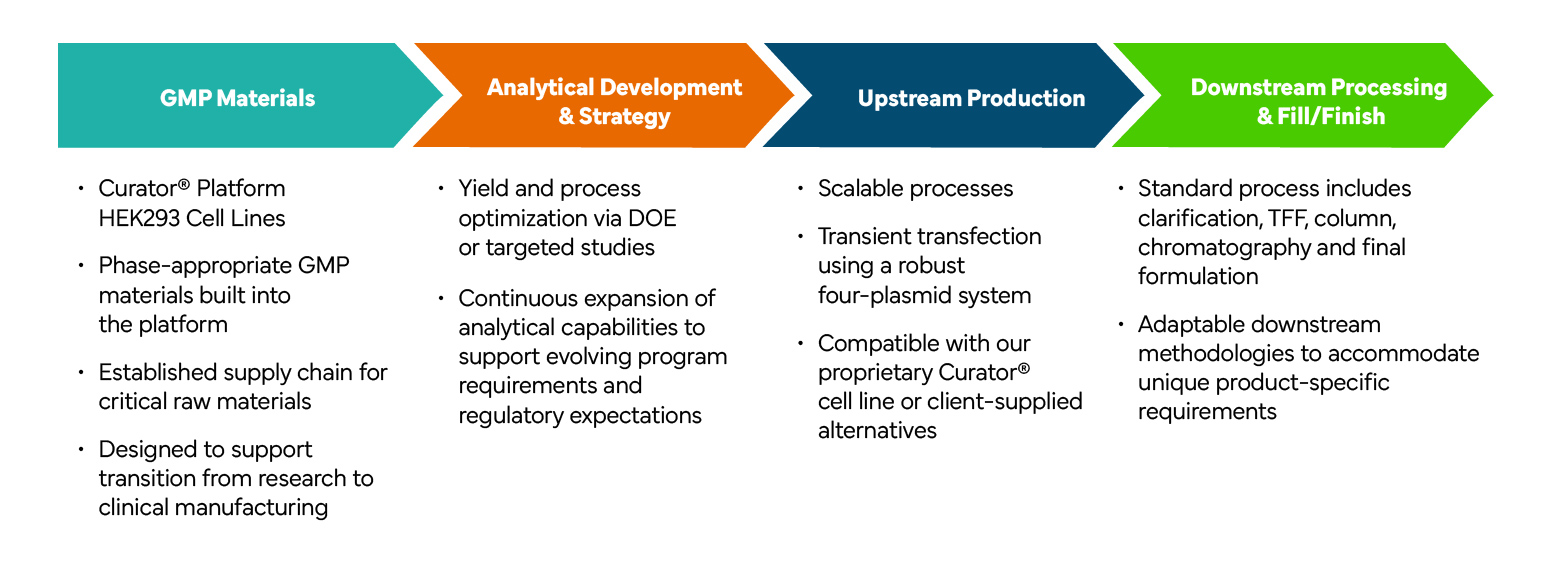
The work is inherently cross-functional. Process development and analytical development must operate together to identify trade offs, interpret functional recovery, evaluate impurity control, and establish an appropriate understanding of product-specific quality attributes.
For sponsors, the objective is not to fit a program into a fixed process. It is to apply relevant platform knowledge while generating product-specific evidence that guides the next decision.
Sponsor Checklist: Five Questions Before the Next Lentivirus Manufacturing Decision
- What does functional titer mean for this product, and do the current methods measure it reliably?
- Which upstream variables are most likely to affect productivity, cell health, and impurity formation?
- Where could the downstream process compromise vector function, even if physical titer appears stable?
- What data will be required to support future scale-up, process changes, and regulatory discussions?
- Does the development model connect process development, analytical development, quality, and program governance?
Conclusion
Lentiviral vectors offer an established and versatile approach to gene delivery. Realizing that potential at scale requires a manufacturing strategy that accounts for the specific nuances of lentiviral vector production, including vector fragility, product-specific variability, and the need to protect functional performance through every stage of the process.
Yield remains important, but it does not fully describe process success. Development teams need to understand how upstream conditions, downstream handling, formulation, storage, and analytical methods affect functional vector recovery.
An integrated development strategy can help sponsors make more informed technical decisions earlier, build product and process knowledge, and prepare for future scale-up and regulatory interactions. Andelyn supports lentivirus manufacturing programs through a configurable platform approach, cross-functional scientific collaboration, commercial-grade quality systems, and transparent partnership.
References
- Valkama AJ, Oruetxebarria I, Lipponen EM, et al. Development of large-scale downstream processing for lentiviral vectors. Molecular Therapy: Methods & Clinical Development. 2020;17:717-730. doi:10.1016/j.omtm.2020.03.025.
- U.S. Food and Drug Administration. Chemistry, Manufacturing, and Control (CMC) Information for Human Gene Therapy Investigational New Drug Applications (INDs): Guidance for Industry. January 2020. Available from: FDA.
- White M, Whittaker R, Gándara C, Stoll EA. A guide to approaching regulatory considerations for lentiviral-mediated gene therapies. Human Gene Therapy Methods. 2017;28(4):163-176. doi:10.1089/hgtb.2017.096.
- Perry C, Rayat ACME. Lentiviral vector bioprocessing. Viruses. 2021;13(2):268. doi:10.3390/v13020268.
- Tang QL, Gu LX, Xu Y, et al. Establishing functional lentiviral vector production in a stirred bioreactor for CAR-T cell therapy. Bioengineered. 2021;12(1):2095-2105. doi:10.1080/21655979.2021.1931644.
- Jadlowsky JK, Leskowitz R, McKenna S, et al. Long-term stability of clinical-grade lentiviral vectors for cell therapy. Molecular Therapy: Methods & Clinical Development. 2024;32:101186. doi:10.1016/j.omtm.2024.101186.
- U.S. Food and Drug Administration. Testing of Retroviral Vector-Based Human Gene Therapy Products for Replication Competent Retrovirus During Product Manufacture and Patient Follow-up: Guidance for Industry. Available from: FDA
- European Medicines Agency. Guideline on Quality, Non-Clinical and Clinical Requirements for Investigational Advanced Therapy Medicinal Products in Clinical Trials. EMA/CAT/22473/2025. Effective July 1, 2025. Available from: EMA.
- U.S. Food and Drug Administration. Long Term Follow-Up After Administration of Human Gene Therapy Products: Guidance for Industry. January 2020. Available from: FDA.
Lentivirus manufacturing requires careful control of functional titer because lentiviral vectors are enveloped, RNA-based particles that can lose biological activity during production, purification, formulation, and storage. The challenge is not simply to produce more particle-associated material. It is to preserve vector function while building the process knowledge required for clinical development, scale-up, and evolving regulatory expectations.
For lentiviral vector programs, physical particle measures and functional measures may provide different views of product quality. Functional titer, often expressed as transducing units, assesses the vector’s biological activity. Physical measures, such as p24-based or nucleic-acid-based measurements, can estimate particle-associated material or vector genome content. Still, they may not independently demonstrate that particles retain the ability to transduce target cells.¹
Questions to Ask About Regulatory and Analytical Support
- Upstream productivity and cell health?
- Downstream vector protection and impurity control?
- Analytical strategy and product understanding?
- Scale-up and regulatory readiness?
This matters because early lentivirus manufacturing decisions can shape future process performance, assay development, comparability assessments, and clinical supply strategy. FDA’s gene therapy CMC guidance emphasizes that sponsors should provide sufficient information to support assessment of product safety, identity, quality, purity, and strength, including potency.²
Why Functional Titer Matters in Lentivirus Manufacturing
Lentiviral vectors are derived from retroviruses and are used in both ex vivo and in vivo gene therapy applications. Conventional integrating lentiviral vectors can transduce dividing and non-dividing cells and support stable genomic integration in target cells, enabling sustained transgene expression.³
The viral lifecycle and payload capacity that make lentiviral vectors valuable therapeutic delivery vehicles also create distinct manufacturing considerations. Lentiviral vectors have a lipid envelope and an RNA genome, both of which contribute to their sensitivity during production and handling. Temperature, freeze-thaw exposure, shear, pH, salt concentration, and buffer osmolality can influence vector stability.⁴ Physical particle measures may appear relatively stable even when functional activity declines.
For that reason, lentivirus manufacturing should be evaluated through the lens of functional recovery, not yield alone. A downstream step that maximizes material recovery but reduces transduction capability may not meaningfully improve the process. Published downstream process-development studies have similarly highlighted the importance of comparing physical particle recovery with functional titer to identify activity loss across processing steps.¹
Functional titer is a process-wide outcome. It reflects the combined effects of vector construct design, cell condition, transfection, harvest timing, purification, formulation, storage, and the assays used to assess product quality.
Table 1. This framework is not meant to create a fixed development sequence for every program. It helps sponsors recognize how decisions in one area can affect outcomes in another.
Dimension One: Building Upstream Productivity Without Losing Product Understanding
Cell fitness is foundational to productive lentivirus manufacturing. Process conditions and vector design can affect cell health, viability, and productivity, including cell density, plasmid quality and ratios, media composition, feeding strategy, pH, dissolved gases, mixing, perfusion, and shear.
For transient-transfection processes, plasmid quality, design, including sequence, and relative quantities are important process inputs that can affect productivity and product safety. FDA recommends that sponsors provide information on plasmids used in gene therapy manufacturing, including their source, characterization, manufacturing procedures, and relevant controls.²
Upstream conditions can also influence the harvest impurity profile. Host-cell-derived material, including extracellular vesicles, may be present alongside the desired vector. The challenge is particularly relevant for enveloped vectors because extracellular vesicles and lentiviral particles can share physical and compositional characteristics that complicate downstream separation.⁴
Construct-specific attributes also require consideration. Engineered envelopes, receptor-targeting ligands, and larger payloads may affect cell fitness, vector productivity, stability, and functional titer.
These effects should be evaluated experimentally for the individual program rather than assumed from a platform baseline.
The transition from adherent to suspension production deserves similar attention. Suspension systems can enable larger-scale manufacture, but they alter the production environment. Process development should reassess cell behavior, transfection performance, mixing, shear exposure, and clarification requirements.
For processes using VSV-G-pseudo typed vectors, teams should also evaluate the potential effects of the pseudo type on producer-cell fitness alongside other suspension-specific process variables. Published studies of stirred-bioreactor lentiviral vector production also show that suspension adaptation and sustained productive cell growth contribute to functional vector output.⁵
A platform approach can create a more informed starting point. It does not eliminate the need to understand how a given vector behaves in each production system.
Dimension Two: Designing Downstream Processing to Protect Functional Vector
In lentivirus manufacturing, stability and purity must be considered together. The objective is not maximum particle recovery alone, but recovery of functional vector with an impurity profile appropriate for the product and stage of development.
Lentiviral vector sensitivity creates practical implications for downstream process design. Processing and hold times, temperature exposure, shear, pH excursions, changes in osmolality, repeated freeze-thaw events, and chromatography conditions, including residence time, should be evaluated for their potential effect on functional recovery.⁴
This is why rapid, controlled processing matters. In a published large-scale downstream lentiviral vector process, the authors identified loss of functionality during processing as a central scale-up challenge and emphasized the importance of short processing times and limited process steps for preserving vector activity.¹
Consider formulation early in development, not only at the end of process development. Buffer composition, pH, osmolality, and excipient selection may influence vector stability, aggregation, and functional recovery. Stability results from one lentiviral vector program should not be generalized automatically to another because construct, process, formulation, and storage conditions can all influence the outcome.⁶
Purification strategy must also account for difficult-to-remove impurities, including residual host-cell DNA, host-cell proteins, extracellular vesicles, and vector-related particle species or other product-related impurities, as relevant to the product and process. FDA’s CMC guidance recommends that sponsors characterize product and process-related impurities and establish controls appropriate to the stage of development and the potential risk to product quality and patient safety.²
Questions to Ask When Evaluating an LVV Downstream Process
- Where hold times are unavoidable, what evidence supports their duration and conditions?
- Which unit operations create the greatest potential risk from shear, temperature, or buffer exposure?
- Which impurities are most likely to co-purify with the desired vector?
- Does the formulation preserve functional activity through expected storage and handling conditions?
- Do recovery metrics assess function as well as particle-associated material?
Dimension Three: Using Analytics to Turn Process Data Into Better Decisions
Analytical development helps establish the relationship between process conditions and product quality. For lentiviral vector programs, no single method is likely to establish product quality on its own. A fit-for-purpose analytical strategy should combine complementary measurements of function, particle-associated material, purity, safety, identity, and stability.
A fit-for-purpose analytical strategy may include methods to assess functional or infectious titer, physical vector measures, potency, purity, residual impurities, stability, identity, and replication-competent lentivirus. Appropriate methods depend on the product, indication, stage of development, and proposed clinical use.
FDA’s CMC guidance identifies potency as a critical aspect of gene therapy product quality and recommends that sponsors describe relevant assays, controls, and acceptance criteria as product knowledgedevelops.² FDA also recognizes that CMC information should evolve with development and that manufacturing changes may require assessment before implementation if they could affect product safety, identity, quality, purity, potency, or stability.²
Interpret functional titer and physical measurements together, where appropriate. Comparing these measures can help teams determine whether a process step maintains vector-associated material while reducing functional activity.¹
Replication-competent lentivirus testing is a separate and essential element of the analytical strategy. FDA guidance for retroviral vector-based human gene therapy products outlines recommendations for testing for replication-competent retrovirus during manufacturing and patient follow-up.⁷
The analytical strategy should support both immediate development decisions and future manufacturing readiness. A strong data package can help teams assess scale-up risk, understand critical quality attributes, support comparability planning, and adapt as scientific and regulatory expectations evolve.
The analytical strategy should support both immediate development decisions and future manufacturing readiness. A strong data package can help teams assess scale-up risk, understand
critical quality attributes, support comparability planning, and adapt as scientific and regulatory expectations evolve.
Dimension Four: Building for Scale and Regulatory Readiness
Lentiviral vector scale-up should be developed with future needs in mind, even when the immediate goal is early clinical supply.
Manufacturing changes are common as programs mature. These can include changes in scale, manufacturing site, raw materials, unit operations, analytical methods, or formulation. FDA notes that manufacturing changes may be necessary during gene therapy development and recommends that sponsors assess changes that could affect safety, identity, quality, purity, potency, or stability.²
In Europe, EMA’s current guideline for investigational advanced therapy medicinal products outlines expectations for development, manufacturing, quality control, nonclinical development, and clinical development. The guideline emphasizes a risk-based approach that is updated as product knowledge grows. It also notes that immature quality development can compromise the ability to use clinical study data in support of a future marketing authorization application.⁸
For integrating vectors, regulatory readiness also includes long-term risk assessment. FDA’s guidance on long-term follow-up explains that integrating vectors, including lentiviral vectors, may require risk-based consideration of delayed adverse events due to the potential for genomic integration.⁹
The practical implication is not that every program must resolve every future commercial or regulatory question during early development. Instead, teams should build the product and process knowledge needed to make future changes more informed, support continuity between development stages, and preserve options as the program advances.
Applying the Framework: An Informed Starting Point, Adapted to the Program
Platform knowledge is valuable when it reduces unnecessary development work while maintaining attention to product-specific risks.
Andelyn’s LVV Curator® Platform provides a configurable starting point for lentivirus manufacturing, applying Optimization-By-Design™ principles, modular process options, and data-informed development. The platform approach connects decisions across cell expansion, transfection, harvest and clarification, concentration and diafiltration, chromatography, final formulation, sterile filtration, and fill.
The work is inherently cross-functional. Process development and analytical development must operate together to identify trade offs, interpret functional recovery, evaluate impurity control, and establish an appropriate understanding of product-specific quality attributes.
For sponsors, the objective is not to fit a program into a fixed process. It is to apply relevant platform knowledge while generating product-specific evidence that guides the next decision.
Sponsor Checklist: Five Questions Before the Next Lentivirus Manufacturing Decision
- What does functional titer mean for this product, and do the current methods measure it reliably?
- Which upstream variables are most likely to affect productivity, cell health, and impurity formation?
- Where could the downstream process compromise vector function, even if physical titer appears stable?
- What data will be required to support future scale-up, process changes, and regulatory discussions?
- Does the development model connect process development, analytical development, quality, and program governance?
Conclusion
Lentiviral vectors offer an established and versatile approach to gene delivery. Realizing that potential at scale requires a manufacturing strategy that accounts for the specific nuances of lentiviral vector production, including vector fragility, product-specific variability, and the need to protect functional performance through every stage of the process.
Yield remains important, but it does not fully describe process success. Development teams need to understand how upstream conditions, downstream handling, formulation, storage, and analytical methods affect functional vector recovery.
An integrated development strategy can help sponsors make more informed technical decisions earlier, build product and process knowledge, and prepare for future scale-up and regulatory interactions. Andelyn supports lentivirus manufacturing programs through a configurable platform approach, cross-functional scientific collaboration, commercial-grade quality systems, and transparent partnership.
References
- Valkama AJ, Oruetxebarria I, Lipponen EM, et al. Development of large-scale downstream processing for lentiviral vectors. Molecular Therapy: Methods & Clinical Development. 2020;17:717-730. doi:10.1016/j.omtm.2020.03.025.
- U.S. Food and Drug Administration. Chemistry, Manufacturing, and Control (CMC) Information for Human Gene Therapy Investigational New Drug Applications (INDs): Guidance for Industry. January 2020. Available from: FDA.
- White M, Whittaker R, Gándara C, Stoll EA. A guide to approaching regulatory considerations for lentiviral-mediated gene therapies. Human Gene Therapy Methods. 2017;28(4):163-176. doi:10.1089/hgtb.2017.096.
- Perry C, Rayat ACME. Lentiviral vector bioprocessing. Viruses. 2021;13(2):268. doi:10.3390/v13020268.
- Tang QL, Gu LX, Xu Y, et al. Establishing functional lentiviral vector production in a stirred bioreactor for CAR-T cell therapy. Bioengineered. 2021;12(1):2095-2105. doi:10.1080/21655979.2021.1931644.
- Jadlowsky JK, Leskowitz R, McKenna S, et al. Long-term stability of clinical-grade lentiviral vectors for cell therapy. Molecular Therapy: Methods & Clinical Development. 2024;32:101186. doi:10.1016/j.omtm.2024.101186.
- U.S. Food and Drug Administration. Testing of Retroviral Vector-Based Human Gene Therapy Products for Replication Competent Retrovirus During Product Manufacture and Patient Follow-up: Guidance for Industry. Available from: FDA
- European Medicines Agency. Guideline on Quality, Non-Clinical and Clinical Requirements for Investigational Advanced Therapy Medicinal Products in Clinical Trials. EMA/CAT/22473/2025. Effective July 1, 2025. Available from: EMA.
- U.S. Food and Drug Administration. Long Term Follow-Up After Administration of Human Gene Therapy Products: Guidance for Industry. January 2020. Available from: FDA.
Lentivirus manufacturing requires careful control of functional titer because lentiviral vectors are enveloped, RNA-based particles that can lose biological activity during production, purification, formulation, and storage. The challenge is not simply to produce more particle-associated material. It is to preserve vector function while building the process knowledge required for clinical development, scale-up, and evolving regulatory expectations.
For lentiviral vector programs, physical particle measures and functional measures may provide different views of product quality. Functional titer, often expressed as transducing units, assesses the vector’s biological activity. Physical measures, such as p24-based or nucleic-acid-based measurements, can estimate particle-associated material or vector genome content. Still, they may not independently demonstrate that particles retain the ability to transduce target cells.¹
Questions to Ask About Regulatory and Analytical Support
- Upstream productivity and cell health?
- Downstream vector protection and impurity control?
- Analytical strategy and product understanding?
- Scale-up and regulatory readiness?
This matters because early lentivirus manufacturing decisions can shape future process performance, assay development, comparability assessments, and clinical supply strategy. FDA’s gene therapy CMC guidance emphasizes that sponsors should provide sufficient information to support assessment of product safety, identity, quality, purity, and strength, including potency.²
Why Functional Titer Matters in Lentivirus Manufacturing
Lentiviral vectors are derived from retroviruses and are used in both ex vivo and in vivo gene therapy applications. Conventional integrating lentiviral vectors can transduce dividing and non-dividing cells and support stable genomic integration in target cells, enabling sustained transgene expression.³
The viral lifecycle and payload capacity that make lentiviral vectors valuable therapeutic delivery vehicles also create distinct manufacturing considerations. Lentiviral vectors have a lipid envelope and an RNA genome, both of which contribute to their sensitivity during production and handling. Temperature, freeze-thaw exposure, shear, pH, salt concentration, and buffer osmolality can influence vector stability.⁴ Physical particle measures may appear relatively stable even when functional activity declines.
For that reason, lentivirus manufacturing should be evaluated through the lens of functional recovery, not yield alone. A downstream step that maximizes material recovery but reduces transduction capability may not meaningfully improve the process. Published downstream process-development studies have similarly highlighted the importance of comparing physical particle recovery with functional titer to identify activity loss across processing steps.¹
Functional titer is a process-wide outcome. It reflects the combined effects of vector construct design, cell condition, transfection, harvest timing, purification, formulation, storage, and the assays used to assess product quality.
Table 1. This framework is not meant to create a fixed development sequence for every program. It helps sponsors recognize how decisions in one area can affect outcomes in another.
Dimension One: Building Upstream Productivity Without Losing Product Understanding
Cell fitness is foundational to productive lentivirus manufacturing. Process conditions and vector design can affect cell health, viability, and productivity, including cell density, plasmid quality and ratios, media composition, feeding strategy, pH, dissolved gases, mixing, perfusion, and shear.
For transient-transfection processes, plasmid quality, design, including sequence, and relative quantities are important process inputs that can affect productivity and product safety. FDA recommends that sponsors provide information on plasmids used in gene therapy manufacturing, including their source, characterization, manufacturing procedures, and relevant controls.²
Upstream conditions can also influence the harvest impurity profile. Host-cell-derived material, including extracellular vesicles, may be present alongside the desired vector. The challenge is particularly relevant for enveloped vectors because extracellular vesicles and lentiviral particles can share physical and compositional characteristics that complicate downstream separation.⁴
Construct-specific attributes also require consideration. Engineered envelopes, receptor-targeting ligands, and larger payloads may affect cell fitness, vector productivity, stability, and functional titer.
These effects should be evaluated experimentally for the individual program rather than assumed from a platform baseline.
The transition from adherent to suspension production deserves similar attention. Suspension systems can enable larger-scale manufacture, but they alter the production environment. Process development should reassess cell behavior, transfection performance, mixing, shear exposure, and clarification requirements.
For processes using VSV-G-pseudo typed vectors, teams should also evaluate the potential effects of the pseudo type on producer-cell fitness alongside other suspension-specific process variables. Published studies of stirred-bioreactor lentiviral vector production also show that suspension adaptation and sustained productive cell growth contribute to functional vector output.⁵
A platform approach can create a more informed starting point. It does not eliminate the need to understand how a given vector behaves in each production system.
Dimension Two: Designing Downstream Processing to Protect Functional Vector
In lentivirus manufacturing, stability and purity must be considered together. The objective is not maximum particle recovery alone, but recovery of functional vector with an impurity profile appropriate for the product and stage of development.
Lentiviral vector sensitivity creates practical implications for downstream process design. Processing and hold times, temperature exposure, shear, pH excursions, changes in osmolality, repeated freeze-thaw events, and chromatography conditions, including residence time, should be evaluated for their potential effect on functional recovery.⁴
This is why rapid, controlled processing matters. In a published large-scale downstream lentiviral vector process, the authors identified loss of functionality during processing as a central scale-up challenge and emphasized the importance of short processing times and limited process steps for preserving vector activity.¹
Consider formulation early in development, not only at the end of process development. Buffer composition, pH, osmolality, and excipient selection may influence vector stability, aggregation, and functional recovery. Stability results from one lentiviral vector program should not be generalized automatically to another because construct, process, formulation, and storage conditions can all influence the outcome.⁶
Purification strategy must also account for difficult-to-remove impurities, including residual host-cell DNA, host-cell proteins, extracellular vesicles, and vector-related particle species or other product-related impurities, as relevant to the product and process. FDA’s CMC guidance recommends that sponsors characterize product and process-related impurities and establish controls appropriate to the stage of development and the potential risk to product quality and patient safety.²
Questions to Ask When Evaluating an LVV Downstream Process
- Where hold times are unavoidable, what evidence supports their duration and conditions?
- Which unit operations create the greatest potential risk from shear, temperature, or buffer exposure?
- Which impurities are most likely to co-purify with the desired vector?
- Does the formulation preserve functional activity through expected storage and handling conditions?
- Do recovery metrics assess function as well as particle-associated material?
Dimension Three: Using Analytics to Turn Process Data Into Better Decisions
Analytical development helps establish the relationship between process conditions and product quality. For lentiviral vector programs, no single method is likely to establish product quality on its own. A fit-for-purpose analytical strategy should combine complementary measurements of function, particle-associated material, purity, safety, identity, and stability.
A fit-for-purpose analytical strategy may include methods to assess functional or infectious titer, physical vector measures, potency, purity, residual impurities, stability, identity, and replication-competent lentivirus. Appropriate methods depend on the product, indication, stage of development, and proposed clinical use.
FDA’s CMC guidance identifies potency as a critical aspect of gene therapy product quality and recommends that sponsors describe relevant assays, controls, and acceptance criteria as product knowledgedevelops.² FDA also recognizes that CMC information should evolve with development and that manufacturing changes may require assessment before implementation if they could affect product safety, identity, quality, purity, potency, or stability.²
Interpret functional titer and physical measurements together, where appropriate. Comparing these measures can help teams determine whether a process step maintains vector-associated material while reducing functional activity.¹
Replication-competent lentivirus testing is a separate and essential element of the analytical strategy. FDA guidance for retroviral vector-based human gene therapy products outlines recommendations for testing for replication-competent retrovirus during manufacturing and patient follow-up.⁷
The analytical strategy should support both immediate development decisions and future manufacturing readiness. A strong data package can help teams assess scale-up risk, understand critical quality attributes, support comparability planning, and adapt as scientific and regulatory expectations evolve.
The analytical strategy should support both immediate development decisions and future manufacturing readiness. A strong data package can help teams assess scale-up risk, understand
critical quality attributes, support comparability planning, and adapt as scientific and regulatory expectations evolve.
Dimension Four: Building for Scale and Regulatory Readiness
Lentiviral vector scale-up should be developed with future needs in mind, even when the immediate goal is early clinical supply.
Manufacturing changes are common as programs mature. These can include changes in scale, manufacturing site, raw materials, unit operations, analytical methods, or formulation. FDA notes that manufacturing changes may be necessary during gene therapy development and recommends that sponsors assess changes that could affect safety, identity, quality, purity, potency, or stability.²
In Europe, EMA’s current guideline for investigational advanced therapy medicinal products outlines expectations for development, manufacturing, quality control, nonclinical development, and clinical development. The guideline emphasizes a risk-based approach that is updated as product knowledge grows. It also notes that immature quality development can compromise the ability to use clinical study data in support of a future marketing authorization application.⁸
For integrating vectors, regulatory readiness also includes long-term risk assessment. FDA’s guidance on long-term follow-up explains that integrating vectors, including lentiviral vectors, may require risk-based consideration of delayed adverse events due to the potential for genomic integration.⁹
The practical implication is not that every program must resolve every future commercial or regulatory question during early development. Instead, teams should build the product and process knowledge needed to make future changes more informed, support continuity between development stages, and preserve options as the program advances.
Applying the Framework: An Informed Starting Point, Adapted to the Program
Platform knowledge is valuable when it reduces unnecessary development work while maintaining attention to product-specific risks.
Andelyn’s LVV Curator® Platform provides a configurable starting point for lentivirus manufacturing, applying Optimization-By-Design™ principles, modular process options, and data-informed development. The platform approach connects decisions across cell expansion, transfection, harvest and clarification, concentration and diafiltration, chromatography, final formulation, sterile filtration, and fill.
The work is inherently cross-functional. Process development and analytical development must operate together to identify trade offs, interpret functional recovery, evaluate impurity control, and establish an appropriate understanding of product-specific quality attributes.
For sponsors, the objective is not to fit a program into a fixed process. It is to apply relevant platform knowledge while generating product-specific evidence that guides the next decision.
Sponsor Checklist: Five Questions Before the Next Lentivirus Manufacturing Decision
- What does functional titer mean for this product, and do the current methods measure it reliably?
- Which upstream variables are most likely to affect productivity, cell health, and impurity formation?
- Where could the downstream process compromise vector function, even if physical titer appears stable?
- What data will be required to support future scale-up, process changes, and regulatory discussions?
- Does the development model connect process development, analytical development, quality, and program governance?
Conclusion
Lentiviral vectors offer an established and versatile approach to gene delivery. Realizing that potential at scale requires a manufacturing strategy that accounts for the specific nuances of lentiviral vector production, including vector fragility, product-specific variability, and the need to protect functional performance through every stage of the process.
Yield remains important, but it does not fully describe process success. Development teams need to understand how upstream conditions, downstream handling, formulation, storage, and analytical methods affect functional vector recovery.
An integrated development strategy can help sponsors make more informed technical decisions earlier, build product and process knowledge, and prepare for future scale-up and regulatory interactions. Andelyn supports lentivirus manufacturing programs through a configurable platform approach, cross-functional scientific collaboration, commercial-grade quality systems, and transparent partnership.
References
- Valkama AJ, Oruetxebarria I, Lipponen EM, et al. Development of large-scale downstream processing for lentiviral vectors. Molecular Therapy: Methods & Clinical Development. 2020;17:717-730. doi:10.1016/j.omtm.2020.03.025.
- U.S. Food and Drug Administration. Chemistry, Manufacturing, and Control (CMC) Information for Human Gene Therapy Investigational New Drug Applications (INDs): Guidance for Industry. January 2020. Available from: FDA.
- White M, Whittaker R, Gándara C, Stoll EA. A guide to approaching regulatory considerations for lentiviral-mediated gene therapies. Human Gene Therapy Methods. 2017;28(4):163-176. doi:10.1089/hgtb.2017.096.
- Perry C, Rayat ACME. Lentiviral vector bioprocessing. Viruses. 2021;13(2):268. doi:10.3390/v13020268.
- Tang QL, Gu LX, Xu Y, et al. Establishing functional lentiviral vector production in a stirred bioreactor for CAR-T cell therapy. Bioengineered. 2021;12(1):2095-2105. doi:10.1080/21655979.2021.1931644.
- Jadlowsky JK, Leskowitz R, McKenna S, et al. Long-term stability of clinical-grade lentiviral vectors for cell therapy. Molecular Therapy: Methods & Clinical Development. 2024;32:101186. doi:10.1016/j.omtm.2024.101186.
- U.S. Food and Drug Administration. Testing of Retroviral Vector-Based Human Gene Therapy Products for Replication Competent Retrovirus During Product Manufacture and Patient Follow-up: Guidance for Industry. Available from: FDA
- European Medicines Agency. Guideline on Quality, Non-Clinical and Clinical Requirements for Investigational Advanced Therapy Medicinal Products in Clinical Trials. EMA/CAT/22473/2025. Effective July 1, 2025. Available from: EMA.
- U.S. Food and Drug Administration. Long Term Follow-Up After Administration of Human Gene Therapy Products: Guidance for Industry. January 2020. Available from: FDA.

About the Author
Victoria Best, Ph.D., is a biotechnology scientist and strategist with experience spanning cell manufacturing, analytical sciences, translational development, and gene therapy. Her work has focused on connecting scientific strategy, manufacturing, and analytical development to advance complex biologic products. Dr. Best holds a Ph.D. in Integrated Biomedical Science from The Ohio State University and has held scientific leadership roles in cell manufacturing, analytics, and translational sciences.