Rethinking the Vector Plasmid Backbone: How Purposeful Design Is Improving Yields and Lowering Cost of Goods
As gene therapies move from rare-disease applications to broader patient populations, one challenge continues to surface across the field: the cost and scalability of plasmid manufacturing. The vector plasmid remains one of the most consistent bottlenecks. Plasmids are difficult to produce in large quantities and often become the rate-limiting step as programs begin to scale.
At Andelyn, we asked a straightforward question: What can we do to improve vector plasmid yields without compromising quality?
The answer led us to redesign the vector backbone itself. Here is what we found and what it means for the therapies our clients are working on to bring to patients.
The Problem: Plasmid Production as a Scaling Bottleneck
For most gene therapy programs, early-stage manufacturing is manageable. However, as programs succeed and patient populations grow, demand for plasmid increases significantly. Larger bioreactor runs require proportionally more plasmid, and the vector plasmid, which is usually the most difficult to produce at high yields, becomes a limiting factor.
This is more than just a manufacturing inconvenience. It directly impacts the cost of goods, project timelines, and ultimately, a sponsor's ability to deliver therapy to those in need. When plasmid costs exceed bioreactor costs by a factor of five, the math does not support sustainable scale-up.
We observe this pattern across our client base. About 85% of the vector plasmids provided by our clients share a common standard backbone design, which has been widely used in the field but was not specifically optimized for high-yield production.
The Approach: Optimizing the Backbone Through Construct Engineering
Our team developed and tested five new backbone constructs, each based on our understanding of how E. coli replicates plasmid DNA. Two of the constructs examined the same concept in different orientations, providing a controlled way to assess the effects of structural changes on growth, yield, and purification.
We began with small 250 mL shake flask cultures to evaluate how each construct influenced E. coli growth kinetics and plasmid replication. The initial results were promising. Our new constructs improved plasmid replication efficiency in bacteria, resulting in higher plasmid yields at harvest.
From there, we selected the three best-performing constructs and scaled them up to 2.5-liter shake flask cultures, running them through our complete plasmid purification process.
The Results: Consistent, Reproducible Improvement
The data tells a clear story across multiple platforms and scales:
Yield Improvements
At the 2.5-liter shake flask scale, the standard vector plasmid produced about 3 mg/L. Our optimized backbone constructs achieved 10–14mg/L, nearly a 4-fold increase.
Higher Recovery Through Purification
Standard vector plasmids usually show about 40% recovery during our purification process. The new constructs reached roughly 60%recovery, a 20-percentage-point boost. This increase indicates cleaner replication by E. coli, with less genomic contamination from host cell proteins, DNA, and RNA carried through each purification step.
Reproducibility Across Platforms
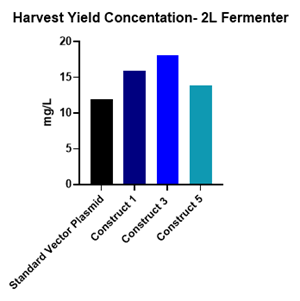
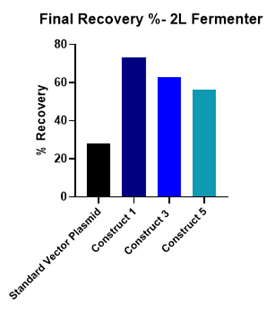
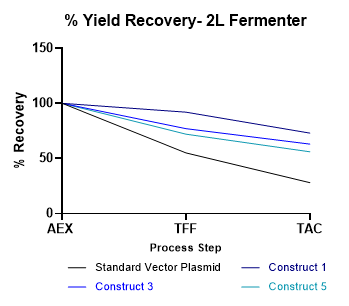
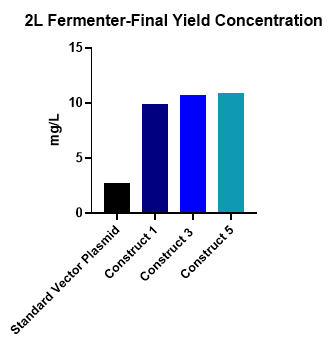
We subsequently scaled these experiments to 2-literfermenter runs and observed the same trends: higher harvest yields, higher final yields, and improved recovery compared to the standard backbone. The consistency of these results across shake flasks and fermenters, and across multiple scale-ups, gives us confidence that the improvements are robust and reproducible.
Why Purity Matters as Much as Yield
Improving yield is important, but it is only part of the equation. The quality of the plasmid backbone has downstream consequences that extend well beyond plasmid manufacturing.
Our data show that the optimized constructs produce plasmids with lower levels of host-cell impurities. This is important because cleaner plasmid inputs can improve outcomes in vector production as well, supporting better ITR stability, which is a known challenge with standard backbone designs, and reducing the amount of unwanted bacterial sequences (such as antibiotic resistance genes) that can be packaged into the final vector product.
When administering therapy, every component matters. Reducing the presence of E. coli-derived sequences in the final product is not merely a manufacturing improvement. It is a quality decision that demonstrates our responsibility to the patients and sponsors who rely on this work being done correctly.
The Downstream Impact: Rethinking Bioreactor Scale
The implications extend beyond plasmid manufacturing. If higher-quality plasmid input leads to improved vector yields from the bioreactor, it changes the scale-up calculus for our clients.
Consider a program planning for a 2,000-liter bioreactor run. With improved plasmid yields and purity, it may be possible to achieve the same output from two 500-liter reactors, or to reduce a planned 200-liter run toa 50-liter run. These are meaningful shifts in infrastructure requirements, cost, and operational complexity.
We are continuing to generate data on these downstream effects through ongoing case studies, and we look forward to sharing those results as they become available.
What Comes Next
This work started with the vector plasmid, but the core approach, optimizing backbone design to enhance E. coli replication of target sequences, has broader uses. We are now expanding this work to helper plasmids and testing the backbone with different reporter genes to ensure the improvements are consistent across various construct types.
We are also working to make this optimized backbone available to our clients. Patent and legal processes are underway, and we expect to begin engaging with clients soon.
This is the kind of work that shows what Andelyn is designed to do: pinpoint the real bottlenecks in gene therapy manufacturing, use thorough science to solve them, and provide solutions that make a real difference for our clients, their programs, and the patients waiting at the end of this work.
This blog post is based on data presented at the American Society of Gene & Cell Therapy (ASGCT) annual meeting. For more information about Andelyn's plasmid manufacturing capabilities and backbone optimization work, contact our team.
As gene therapies move from rare-disease applications to broader patient populations, one challenge continues to surface across the field: the cost and scalability of plasmid manufacturing. The vector plasmid remains one of the most consistent bottlenecks. Plasmids are difficult to produce in large quantities and often become the rate-limiting step as programs begin to scale.
At Andelyn, we asked a straightforward question: What can we do to improve vector plasmid yields without compromising quality?
The answer led us to redesign the vector backbone itself. Here is what we found and what it means for the therapies our clients are working on to bring to patients.
The Problem: Plasmid Production as a Scaling Bottleneck
For most gene therapy programs, early-stage manufacturing is manageable. However, as programs succeed and patient populations grow, demand for plasmid increases significantly. Larger bioreactor runs require proportionally more plasmid, and the vector plasmid, which is usually the most difficult to produce at high yields, becomes a limiting factor.
This is more than just a manufacturing inconvenience. It directly impacts the cost of goods, project timelines, and ultimately, a sponsor's ability to deliver therapy to those in need. When plasmid costs exceed bioreactor costs by a factor of five, the math does not support sustainable scale-up.
We observe this pattern across our client base. About 85% of the vector plasmids provided by our clients share a common standard backbone design, which has been widely used in the field but was not specifically optimized for high-yield production.
The Approach: Optimizing the Backbone Through Construct Engineering
Our team developed and tested five new backbone constructs, each based on our understanding of how E. coli replicates plasmid DNA. Two of the constructs examined the same concept in different orientations, providing a controlled way to assess the effects of structural changes on growth, yield, and purification.
We began with small 250 mL shake flask cultures to evaluate how each construct influenced E. coli growth kinetics and plasmid replication. The initial results were promising. Our new constructs improved plasmid replication efficiency in bacteria, resulting in higher plasmid yields at harvest.
From there, we selected the three best-performing constructs and scaled them up to 2.5-liter shake flask cultures, running them through our complete plasmid purification process.
The Results: Consistent, Reproducible Improvement
The data tells a clear story across multiple platforms and scales:
Yield Improvements
At the 2.5-liter shake flask scale, the standard vector plasmid produced about 3 mg/L. Our optimized backbone constructs achieved 10–14mg/L, nearly a 4-fold increase.
Higher Recovery Through Purification
Standard vector plasmids usually show about 40% recovery during our purification process. The new constructs reached roughly 60%recovery, a 20-percentage-point boost. This increase indicates cleaner replication by E. coli, with less genomic contamination from host cell proteins, DNA, and RNA carried through each purification step.
Reproducibility Across Platforms
We subsequently scaled these experiments to 2-literfermenter runs and observed the same trends: higher harvest yields, higher final yields, and improved recovery compared to the standard backbone. The consistency of these results across shake flasks and fermenters, and across multiple scale-ups, gives us confidence that the improvements are robust and reproducible.
Why Purity Matters as Much as Yield
Improving yield is important, but it is only part of the equation. The quality of the plasmid backbone has downstream consequences that extend well beyond plasmid manufacturing.
Our data show that the optimized constructs produce plasmids with lower levels of host-cell impurities. This is important because cleaner plasmid inputs can improve outcomes in vector production as well, supporting better ITR stability, which is a known challenge with standard backbone designs, and reducing the amount of unwanted bacterial sequences (such as antibiotic resistance genes) that can be packaged into the final vector product.
When administering therapy, every component matters. Reducing the presence of E. coli-derived sequences in the final product is not merely a manufacturing improvement. It is a quality decision that demonstrates our responsibility to the patients and sponsors who rely on this work being done correctly.
The Downstream Impact: Rethinking Bioreactor Scale
The implications extend beyond plasmid manufacturing. If higher-quality plasmid input leads to improved vector yields from the bioreactor, it changes the scale-up calculus for our clients.
Consider a program planning for a 2,000-liter bioreactor run. With improved plasmid yields and purity, it may be possible to achieve the same output from two 500-liter reactors, or to reduce a planned 200-liter run toa 50-liter run. These are meaningful shifts in infrastructure requirements, cost, and operational complexity.
We are continuing to generate data on these downstream effects through ongoing case studies, and we look forward to sharing those results as they become available.
What Comes Next
This work started with the vector plasmid, but the core approach, optimizing backbone design to enhance E. coli replication of target sequences, has broader uses. We are now expanding this work to helper plasmids and testing the backbone with different reporter genes to ensure the improvements are consistent across various construct types.
We are also working to make this optimized backbone available to our clients. Patent and legal processes are underway, and we expect to begin engaging with clients soon.
This is the kind of work that shows what Andelyn is designed to do: pinpoint the real bottlenecks in gene therapy manufacturing, use thorough science to solve them, and provide solutions that make a real difference for our clients, their programs, and the patients waiting at the end of this work.
This blog post is based on data presented at the American Society of Gene & Cell Therapy (ASGCT) annual meeting. For more information about Andelyn's plasmid manufacturing capabilities and backbone optimization work, contact our team.
As gene therapies move from rare-disease applications to broader patient populations, one challenge continues to surface across the field: the cost and scalability of plasmid manufacturing. The vector plasmid remains one of the most consistent bottlenecks. Plasmids are difficult to produce in large quantities and often become the rate-limiting step as programs begin to scale.
At Andelyn, we asked a straightforward question: What can we do to improve vector plasmid yields without compromising quality?
The answer led us to redesign the vector backbone itself. Here is what we found and what it means for the therapies our clients are working on to bring to patients.
The Problem: Plasmid Production as a Scaling Bottleneck
For most gene therapy programs, early-stage manufacturing is manageable. However, as programs succeed and patient populations grow, demand for plasmid increases significantly. Larger bioreactor runs require proportionally more plasmid, and the vector plasmid, which is usually the most difficult to produce at high yields, becomes a limiting factor.
This is more than just a manufacturing inconvenience. It directly impacts the cost of goods, project timelines, and ultimately, a sponsor's ability to deliver therapy to those in need. When plasmid costs exceed bioreactor costs by a factor of five, the math does not support sustainable scale-up.
We observe this pattern across our client base. About 85% of the vector plasmids provided by our clients share a common standard backbone design, which has been widely used in the field but was not specifically optimized for high-yield production.
The Approach: Optimizing the Backbone Through Construct Engineering
Our team developed and tested five new backbone constructs, each based on our understanding of how E. coli replicates plasmid DNA. Two of the constructs examined the same concept in different orientations, providing a controlled way to assess the effects of structural changes on growth, yield, and purification.
We began with small 250 mL shake flask cultures to evaluate how each construct influenced E. coli growth kinetics and plasmid replication. The initial results were promising. Our new constructs improved plasmid replication efficiency in bacteria, resulting in higher plasmid yields at harvest.
From there, we selected the three best-performing constructs and scaled them up to 2.5-liter shake flask cultures, running them through our complete plasmid purification process.
The Results: Consistent, Reproducible Improvement
The data tells a clear story across multiple platforms and scales:
Yield Improvements
At the 2.5-liter shake flask scale, the standard vector plasmid produced about 3 mg/L. Our optimized backbone constructs achieved 10–14mg/L, nearly a 4-fold increase.
Higher Recovery Through Purification
Standard vector plasmids usually show about 40% recovery during our purification process. The new constructs reached roughly 60%recovery, a 20-percentage-point boost. This increase indicates cleaner replication by E. coli, with less genomic contamination from host cell proteins, DNA, and RNA carried through each purification step.
Reproducibility Across Platforms
We subsequently scaled these experiments to 2-literfermenter runs and observed the same trends: higher harvest yields, higher final yields, and improved recovery compared to the standard backbone. The consistency of these results across shake flasks and fermenters, and across multiple scale-ups, gives us confidence that the improvements are robust and reproducible.
Why Purity Matters as Much as Yield
Improving yield is important, but it is only part of the equation. The quality of the plasmid backbone has downstream consequences that extend well beyond plasmid manufacturing.
Our data show that the optimized constructs produce plasmids with lower levels of host-cell impurities. This is important because cleaner plasmid inputs can improve outcomes in vector production as well, supporting better ITR stability, which is a known challenge with standard backbone designs, and reducing the amount of unwanted bacterial sequences (such as antibiotic resistance genes) that can be packaged into the final vector product.
When administering therapy, every component matters. Reducing the presence of E. coli-derived sequences in the final product is not merely a manufacturing improvement. It is a quality decision that demonstrates our responsibility to the patients and sponsors who rely on this work being done correctly.
The Downstream Impact: Rethinking Bioreactor Scale
The implications extend beyond plasmid manufacturing. If higher-quality plasmid input leads to improved vector yields from the bioreactor, it changes the scale-up calculus for our clients.
Consider a program planning for a 2,000-liter bioreactor run. With improved plasmid yields and purity, it may be possible to achieve the same output from two 500-liter reactors, or to reduce a planned 200-liter run toa 50-liter run. These are meaningful shifts in infrastructure requirements, cost, and operational complexity.
We are continuing to generate data on these downstream effects through ongoing case studies, and we look forward to sharing those results as they become available.
What Comes Next
This work started with the vector plasmid, but the core approach, optimizing backbone design to enhance E. coli replication of target sequences, has broader uses. We are now expanding this work to helper plasmids and testing the backbone with different reporter genes to ensure the improvements are consistent across various construct types.
We are also working to make this optimized backbone available to our clients. Patent and legal processes are underway, and we expect to begin engaging with clients soon.
This is the kind of work that shows what Andelyn is designed to do: pinpoint the real bottlenecks in gene therapy manufacturing, use thorough science to solve them, and provide solutions that make a real difference for our clients, their programs, and the patients waiting at the end of this work.
This blog post is based on data presented at the American Society of Gene & Cell Therapy (ASGCT) annual meeting. For more information about Andelyn's plasmid manufacturing capabilities and backbone optimization work, contact our team.