Why Location Matters in Gene Therapy CDMO Selection
Will Fountain | Head of Analytical Development
Laura Prugar | Senior Program Manager
Chrystal Montgomery | AD Business Operations
Choosing the right contract development and manufacturing organization (CDMO) partner is a pivotal decision for a biotech company. Key criteria for CDMO selection include quality and compliance, capabilities and capacity, experience, and location.
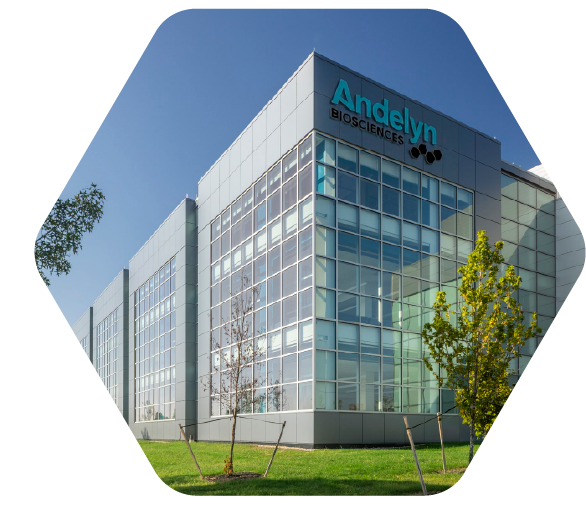
Operating out of its development and manufacturing facilities in Columbus, Ohio, Andelyn supports its clients in developing cell and gene therapies from concept through process and analytical development, and into cGMP clinical and commercial manufacturing.
The location of your CDMO partner is especially important given evolving geopolitics and the broader program strategy. For gene therapy programs, the CDMO location is particularly significant due to factors specific to these therapies, such as ongoing technological advances, evolving regulatory expectations, and the need for ready access to both patient populations and funding. These factors point to the United States as the best location for a gene therapy CDMO partner, even for drug developers based elsewhere.
Addressing the Needs of Gene Therapy
Developing while scaling
Gene therapy development continues to advance, driven by significant technological advancements that improve efficiency, scalability, and cost-effectiveness. In this situation, where processes and platforms are still not fully defined, manufacturing technical experience and troubleshooting skills are important for success.
Shifting regulatory expectations
Regulatory expectations are evolving in parallel with advances in process and material technologies as more gene therapy products enter clinical development. This means that a close relationship with the regulatory agencies is paramount. The Alliance for Regenerative Medicines (ARM) reported that 384 gene therapy trials were underway in the United States in 2024, vs only 188 in Europe, making the U.S. the global hub for gene therapy trials.1 In this context, a manufacturing partner with an ongoing relationship with the U.S. FDA and that understands the FDA’s expectations of gene therapies can help expedite and streamline program development into the clinic.
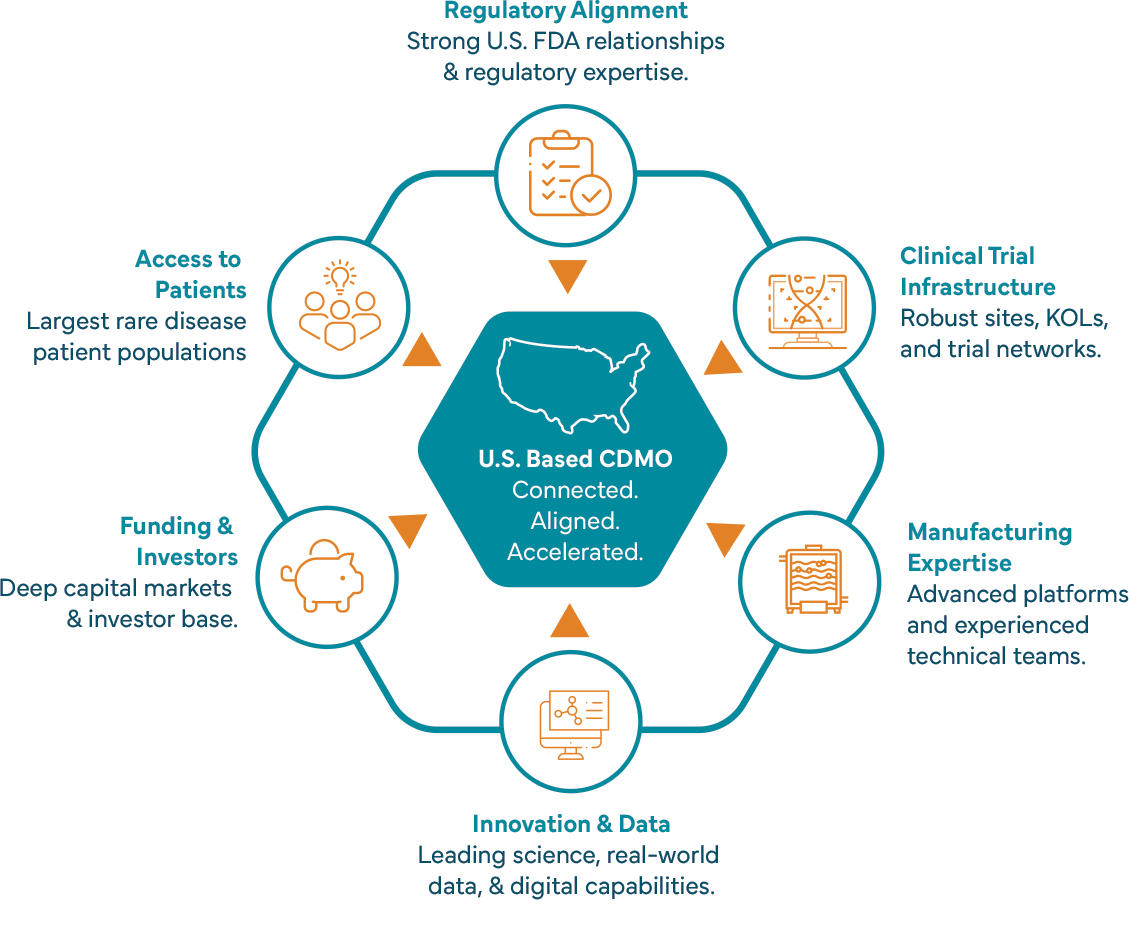
U.S.-based CDMOs connect drug developers to the regulatory, clinical, operational, and financial resources needed to accelerate gene therapy programs from development through commercialization.
Rare indications drive the need to access patient pools
Unlike other treatment modalities, many gene therapy programs target rare diseases, resulting in a smaller patient population for clinical trials. This makes the large patient pool in the United States a good location for gene therapy trials.
Follow the money
Financing is another important feature of this sector. Despite continued investment in gene therapy research, which is heavily focused on translational research funded by both public and private sources, challenges related to cost and the potential impact of funding cuts remain important considerations.
According to ARM, 78% of the available funding for advanced therapies is concentrated in the United States.2 Therefore, partnering with a U.S.-based CDMO is relevant for fundraising efforts.
Criteria for CDMO Selection for Gene Therapy
Gene therapy companies continue to navigate technological and regulatory challenges in drug commercialization while seeking innovative ways to extend their cash runway. Partnering with a CDMO with the expertise to shepherd your product through development is crucial. Establishing selection factors early will help ensure the right CDMO program is chosen for the gene therapy program.
Baseline building blocks: quality and compliance
Your CDMO partner must adhere to international regulatory standards (e.g., FDA, EMA, ICH) and have a strong track record. It should have a demonstrated focus on quality, with robust systems in place to ensure consistent product quality and control.
Drivers for success: experience, data, and the ability to troubleshoot
Most gene therapy CDMOs now offer access to a manufacturing platform. However, the complexity and nascent nature of viral vector manufacturing demand more than a platform partner; success depends on technical and operational teams with the experience to troubleshoot and address the specific needs of each program.
What About the Role of Location for CDMO Selection?
What if you find a CDMO partner that provides quality and compliance, capabilities, experience, and a range of service offerings to ensure a smooth pathway into GMP manufacturing and commercialization? It could be that this ideal CDMO partner is located in a different geography from the sponsor.
Working with a CDMO that is not local raises important questions:
• How will day-to-day operations and communication be managed?
• Since troubleshooting is so important, how can we ensure the sponsor and CDMO work together to drive program success?
Access is more important than proximity
Drug developers who choose a CDMO because it’s nearby may be frustrated to find they have limited access to technical leadership teams with the vast experience necessary to drive success.
Geographical proximity is no guarantee of effective collaboration. In this context, it’s important to understand the CDMO’s project governance approach, Person-In-Plant (PIP) policy, and overall philosophy on collaborating with clients. This ensures transparency and trust, as well as fostering strong, collaborative client engagement.
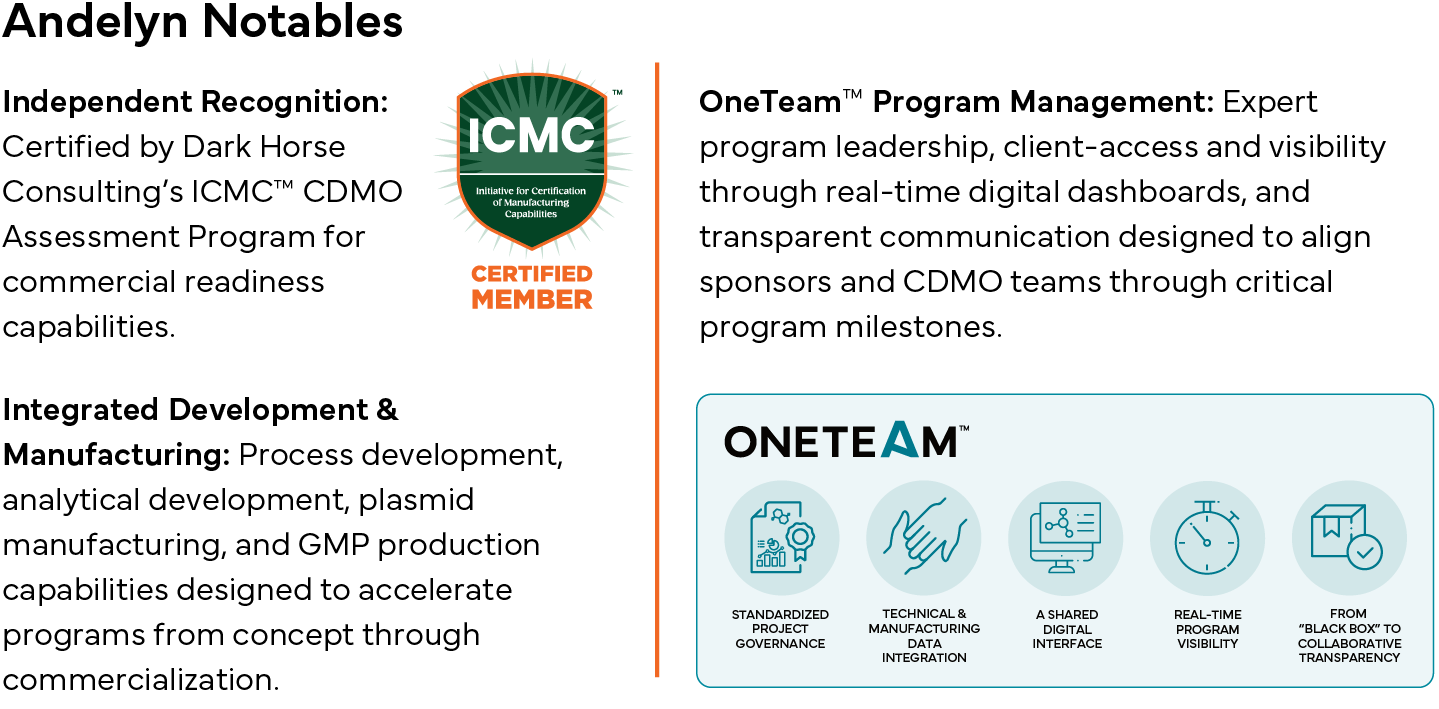
Another key element of partnership success is strong program management, which can enhance alignment across all aspects of a drug developer’s efforts. Effective program management should include clear ownership and accountability, standardized processes, direct communication at multiple organizational levels, and real-time visibility into program status through digital dashboards and data-sharing tools. Together, these capabilities promote transparency, accelerate decision-making, and facilitate essential information exchange between the client and the CDMO.
How location can impact the delivery of specific capabilities
Many gene therapy CDMOs are end-to-end suppliers able to support clients with plasmid manufacturing, development, and preclinical services, clinical production, and analytical capabilities. Sometimes these services are offered from multiple sites around the globe that have been integrated through acquisitions. A CDMO might produce plasmids in Europe, manufacture viral vectors in the United States, and then turn to a site in another country for analytical testing or drug product manufacturing. This physical spread of functions across multiple locations increases complexity for drug developers, requiring them to interact globally with different project managers, processes, and systems, ultimately leading to inefficiency.
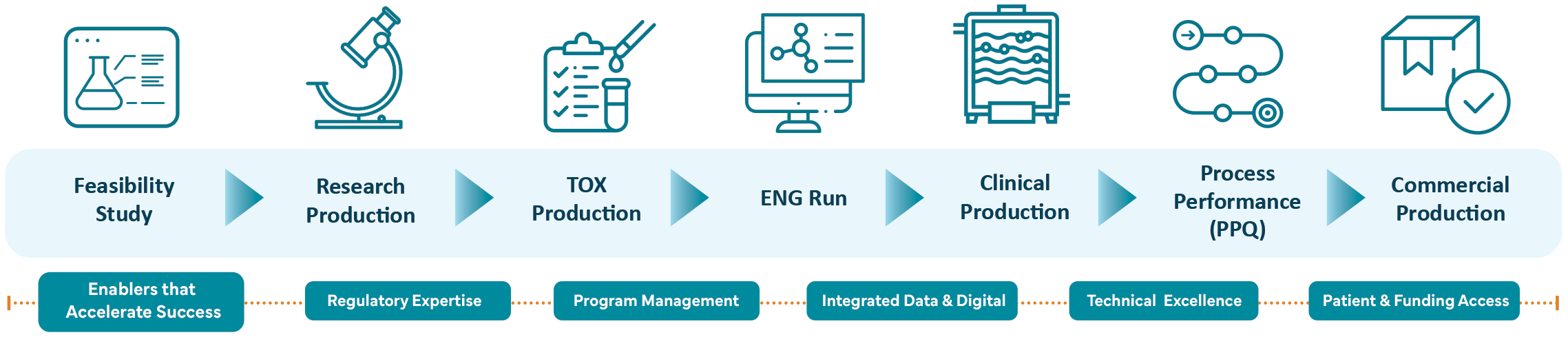
Having facilities concentrated in one location drives efficient communication and tech transfers, whether external or internal to CDMO. From plasmids to viral vectors, and from preclinical to GMP, this concentration of services from one geographic location accelerates a client’s gene therapy program from concept to commercialization.
Location impacts outsourcing strategy
The location of a gene therapy CDMO should align with a drug development company’s day-to-day operational needs and its overarching outsourcing strategy. Given the need to access an appropriate patient pool, raise
funds, and interact with the FDA, the decision is less about geography alone and more about the broader ecosystem the CDMO offers. For example, partnering with a CDMO that is part of a strong U.S. network of
organizations can help accelerate programs to the clinical trial stage.
Location redefined in the digital world
A significant challenge for biotech companies, especially when leveraging multiple partners such as CDMOs, clinical trial organizations (CTOs), and clinical research organizations (CROs), is managing disconnected data and limited access to the insights it provides throughout the development lifecycle. A gene therapy CDMO must be more than a drug manufacturer; it must also be a data company. It must harness the power of modern tools, including artificial intelligence, to maximize data value and drive insights, while ensuring critical data assets are compliant and secure.
Beyond Borders: Accelerating Gene Therapies with the Right CDMO Partner
Success in gene therapy depends on overcoming complexities in development and manufacturing. A well-positioned U.S.-based CDMO offers overseas drug developers a strategic gateway into the U.S. market through streamlined navigation of the FDA regulatory process, access to a larger patient population, and a smoother path to U.S. clinical trials. Finally, partnering with a U.S. manufacturer can also open doors to funding opportunities through local networks and partnerships to support growth and innovation.
The right U.S.-based partner will reduce risk, accelerate and facilitate the path to manufacturing, and bring life-changing gene therapies to patients faster and more efficiently, with the highest quality standards.

References
1. Alliance for Regenerative Medicine, 2024 Clinical Trials.
2. C. Strode, From innovation to international impact: ARM’s 2025 “State of the Industry Briefing” showcases maturing CGT industry, Jan 20, 2025.
Will Fountain | Head of Analytical Development
Laura Prugar | Senior Program Manager
Chrystal Montgomery | AD Business Operations
Choosing the right contract development and manufacturing organization (CDMO) partner is a pivotal decision for a biotech company. Key criteria for CDMO selection include quality and compliance, capabilities and capacity, experience, and location.
Operating out of its development and manufacturing facilities in Columbus, Ohio, Andelyn supports its clients in developing cell and gene therapies from concept through process and analytical development, and into cGMP clinical and commercial manufacturing.
The location of your CDMO partner is especially important given evolving geopolitics and the broader program strategy. For gene therapy programs, the CDMO location is particularly significant due to factors specific to these therapies, such as ongoing technological advances, evolving regulatory expectations, and the need for ready access to both patient populations and funding. These factors point to the United States as the best location for a gene therapy CDMO partner, even for drug developers based elsewhere.
Addressing the Needs of Gene Therapy
Developing while scaling
Gene therapy development continues to advance, driven by significant technological advancements that improve efficiency, scalability, and cost-effectiveness. In this situation, where processes and platforms are still not fully defined, manufacturing technical experience and troubleshooting skills are important for success.
Shifting regulatory expectations
Regulatory expectations are evolving in parallel with advances in process and material technologies as more gene therapy products enter clinical development. This means that a close relationship with the regulatory agencies is paramount. The Alliance for Regenerative Medicines (ARM) reported that 384 gene therapy trials were underway in the United States in 2024, vs only 188 in Europe, making the U.S. the global hub for gene therapy trials.1 In this context, a manufacturing partner with an ongoing relationship with the U.S. FDA and that understands the FDA’s expectations of gene therapies can help expedite and streamline program development into the clinic.
U.S.-based CDMOs connect drug developers to the regulatory, clinical, operational, and financial resources needed to accelerate gene therapy programs from development through commercialization.
Rare indications drive the need to access patient pools
Unlike other treatment modalities, many gene therapy programs target rare diseases, resulting in a smaller patient population for clinical trials. This makes the large patient pool in the United States a good location for gene therapy trials.
Follow the money
Financing is another important feature of this sector. Despite continued investment in gene therapy research, which is heavily focused on translational research funded by both public and private sources, challenges related to cost and the potential impact of funding cuts remain important considerations.
According to ARM, 78% of the available funding for advanced therapies is concentrated in the United States.2 Therefore, partnering with a U.S.-based CDMO is relevant for fundraising efforts.
Criteria for CDMO Selection for Gene Therapy
Gene therapy companies continue to navigate technological and regulatory challenges in drug commercialization while seeking innovative ways to extend their cash runway. Partnering with a CDMO with the expertise to shepherd your product through development is crucial. Establishing selection factors early will help ensure the right CDMO program is chosen for the gene therapy program.
Baseline building blocks: quality and compliance
Your CDMO partner must adhere to international regulatory standards (e.g., FDA, EMA, ICH) and have a strong track record. It should have a demonstrated focus on quality, with robust systems in place to ensure consistent product quality and control.
Drivers for success: experience, data, and the ability to troubleshoot
Most gene therapy CDMOs now offer access to a manufacturing platform. However, the complexity and nascent nature of viral vector manufacturing demand more than a platform partner; success depends on technical and operational teams with the experience to troubleshoot and address the specific needs of each program.
What About the Role of Location for CDMO Selection?
What if you find a CDMO partner that provides quality and compliance, capabilities, experience, and a range of service offerings to ensure a smooth pathway into GMP manufacturing and commercialization? It could be that this ideal CDMO partner is located in a different geography from the sponsor.
Working with a CDMO that is not local raises important questions:
• How will day-to-day operations and communication be managed?
• Since troubleshooting is so important, how can we ensure the sponsor and CDMO work together to drive program success?
Access is more important than proximity
Drug developers who choose a CDMO because it’s nearby may be frustrated to find they have limited access to technical leadership teams with the vast experience necessary to drive success.
Geographical proximity is no guarantee of effective collaboration. In this context, it’s important to understand the CDMO’s project governance approach, Person-In-Plant (PIP) policy, and overall philosophy on collaborating with clients. This ensures transparency and trust, as well as fostering strong, collaborative client engagement.
Another key element of partnership success is strong program management, which can enhance alignment across all aspects of a drug developer’s efforts. Effective program management should include clear ownership and accountability, standardized processes, direct communication at multiple organizational levels, and real-time visibility into program status through digital dashboards and data-sharing tools. Together, these capabilities promote transparency, accelerate decision-making, and facilitate essential information exchange between the client and the CDMO.
How location can impact the delivery of specific capabilities
Many gene therapy CDMOs are end-to-end suppliers able to support clients with plasmid manufacturing, development, and preclinical services, clinical production, and analytical capabilities. Sometimes these services are offered from multiple sites around the globe that have been integrated through acquisitions. A CDMO might produce plasmids in Europe, manufacture viral vectors in the United States, and then turn to a site in another country for analytical testing or drug product manufacturing. This physical spread of functions across multiple locations increases complexity for drug developers, requiring them to interact globally with different project managers, processes, and systems, ultimately leading to inefficiency.
Having facilities concentrated in one location drives efficient communication and tech transfers, whether external or internal to CDMO. From plasmids to viral vectors, and from preclinical to GMP, this concentration of services from one geographic location accelerates a client’s gene therapy program from concept to commercialization.
Location impacts outsourcing strategy
The location of a gene therapy CDMO should align with a drug development company’s day-to-day operational needs and its overarching outsourcing strategy. Given the need to access an appropriate patient pool, raise
funds, and interact with the FDA, the decision is less about geography alone and more about the broader ecosystem the CDMO offers. For example, partnering with a CDMO that is part of a strong U.S. network of
organizations can help accelerate programs to the clinical trial stage.
Location redefined in the digital world
A significant challenge for biotech companies, especially when leveraging multiple partners such as CDMOs, clinical trial organizations (CTOs), and clinical research organizations (CROs), is managing disconnected data and limited access to the insights it provides throughout the development lifecycle. A gene therapy CDMO must be more than a drug manufacturer; it must also be a data company. It must harness the power of modern tools, including artificial intelligence, to maximize data value and drive insights, while ensuring critical data assets are compliant and secure.
Beyond Borders: Accelerating Gene Therapies with the Right CDMO Partner
Success in gene therapy depends on overcoming complexities in development and manufacturing. A well-positioned U.S.-based CDMO offers overseas drug developers a strategic gateway into the U.S. market through streamlined navigation of the FDA regulatory process, access to a larger patient population, and a smoother path to U.S. clinical trials. Finally, partnering with a U.S. manufacturer can also open doors to funding opportunities through local networks and partnerships to support growth and innovation.
The right U.S.-based partner will reduce risk, accelerate and facilitate the path to manufacturing, and bring life-changing gene therapies to patients faster and more efficiently, with the highest quality standards.
References
1. Alliance for Regenerative Medicine, 2024 Clinical Trials.
2. C. Strode, From innovation to international impact: ARM’s 2025 “State of the Industry Briefing” showcases maturing CGT industry, Jan 20, 2025.
Will Fountain | Head of Analytical Development
Laura Prugar | Senior Program Manager
Chrystal Montgomery | AD Business Operations
Choosing the right contract development and manufacturing organization (CDMO) partner is a pivotal decision for a biotech company. Key criteria for CDMO selection include quality and compliance, capabilities and capacity, experience, and location.
Operating out of its development and manufacturing facilities in Columbus, Ohio, Andelyn supports its clients in developing cell and gene therapies from concept through process and analytical development, and into cGMP clinical and commercial manufacturing.
The location of your CDMO partner is especially important given evolving geopolitics and the broader program strategy. For gene therapy programs, the CDMO location is particularly significant due to factors specific to these therapies, such as ongoing technological advances, evolving regulatory expectations, and the need for ready access to both patient populations and funding. These factors point to the United States as the best location for a gene therapy CDMO partner, even for drug developers based elsewhere.
Addressing the Needs of Gene Therapy
Developing while scaling
Gene therapy development continues to advance, driven by significant technological advancements that improve efficiency, scalability, and cost-effectiveness. In this situation, where processes and platforms are still not fully defined, manufacturing technical experience and troubleshooting skills are important for success.
Shifting regulatory expectations
Regulatory expectations are evolving in parallel with advances in process and material technologies as more gene therapy products enter clinical development. This means that a close relationship with the regulatory agencies is paramount. The Alliance for Regenerative Medicines (ARM) reported that 384 gene therapy trials were underway in the United States in 2024, vs only 188 in Europe, making the U.S. the global hub for gene therapy trials.1 In this context, a manufacturing partner with an ongoing relationship with the U.S. FDA and that understands the FDA’s expectations of gene therapies can help expedite and streamline program development into the clinic.
U.S.-based CDMOs connect drug developers to the regulatory, clinical, operational, and financial resources needed to accelerate gene therapy programs from development through commercialization.
Rare indications drive the need to access patient pools
Unlike other treatment modalities, many gene therapy programs target rare diseases, resulting in a smaller patient population for clinical trials. This makes the large patient pool in the United States a good location for gene therapy trials.
Follow the money
Financing is another important feature of this sector. Despite continued investment in gene therapy research, which is heavily focused on translational research funded by both public and private sources, challenges related to cost and the potential impact of funding cuts remain important considerations.
According to ARM, 78% of the available funding for advanced therapies is concentrated in the United States.2 Therefore, partnering with a U.S.-based CDMO is relevant for fundraising efforts.
Criteria for CDMO Selection for Gene Therapy
Gene therapy companies continue to navigate technological and regulatory challenges in drug commercialization while seeking innovative ways to extend their cash runway. Partnering with a CDMO with the expertise to shepherd your product through development is crucial. Establishing selection factors early will help ensure the right CDMO program is chosen for the gene therapy program.
Baseline building blocks: quality and compliance
Your CDMO partner must adhere to international regulatory standards (e.g., FDA, EMA, ICH) and have a strong track record. It should have a demonstrated focus on quality, with robust systems in place to ensure consistent product quality and control.
Drivers for success: experience, data, and the ability to troubleshoot
Most gene therapy CDMOs now offer access to a manufacturing platform. However, the complexity and nascent nature of viral vector manufacturing demand more than a platform partner; success depends on technical and operational teams with the experience to troubleshoot and address the specific needs of each program.
What About the Role of Location for CDMO Selection?
What if you find a CDMO partner that provides quality and compliance, capabilities, experience, and a range of service offerings to ensure a smooth pathway into GMP manufacturing and commercialization? It could be that this ideal CDMO partner is located in a different geography from the sponsor.
Working with a CDMO that is not local raises important questions:
• How will day-to-day operations and communication be managed?
• Since troubleshooting is so important, how can we ensure the sponsor and CDMO work together to drive program success?
Access is more important than proximity
Drug developers who choose a CDMO because it’s nearby may be frustrated to find they have limited access to technical leadership teams with the vast experience necessary to drive success.
Geographical proximity is no guarantee of effective collaboration. In this context, it’s important to understand the CDMO’s project governance approach, Person-In-Plant (PIP) policy, and overall philosophy on collaborating with clients. This ensures transparency and trust, as well as fostering strong, collaborative client engagement.
Another key element of partnership success is strong program management, which can enhance alignment across all aspects of a drug developer’s efforts. Effective program management should include clear ownership and accountability, standardized processes, direct communication at multiple organizational levels, and real-time visibility into program status through digital dashboards and data-sharing tools. Together, these capabilities promote transparency, accelerate decision-making, and facilitate essential information exchange between the client and the CDMO.
How location can impact the delivery of specific capabilities
Many gene therapy CDMOs are end-to-end suppliers able to support clients with plasmid manufacturing, development, and preclinical services, clinical production, and analytical capabilities. Sometimes these services are offered from multiple sites around the globe that have been integrated through acquisitions. A CDMO might produce plasmids in Europe, manufacture viral vectors in the United States, and then turn to a site in another country for analytical testing or drug product manufacturing. This physical spread of functions across multiple locations increases complexity for drug developers, requiring them to interact globally with different project managers, processes, and systems, ultimately leading to inefficiency.
Having facilities concentrated in one location drives efficient communication and tech transfers, whether external or internal to CDMO. From plasmids to viral vectors, and from preclinical to GMP, this concentration of services from one geographic location accelerates a client’s gene therapy program from concept to commercialization.
Location impacts outsourcing strategy
The location of a gene therapy CDMO should align with a drug development company’s day-to-day operational needs and its overarching outsourcing strategy. Given the need to access an appropriate patient pool, raise
funds, and interact with the FDA, the decision is less about geography alone and more about the broader ecosystem the CDMO offers. For example, partnering with a CDMO that is part of a strong U.S. network of
organizations can help accelerate programs to the clinical trial stage.
Location redefined in the digital world
A significant challenge for biotech companies, especially when leveraging multiple partners such as CDMOs, clinical trial organizations (CTOs), and clinical research organizations (CROs), is managing disconnected data and limited access to the insights it provides throughout the development lifecycle. A gene therapy CDMO must be more than a drug manufacturer; it must also be a data company. It must harness the power of modern tools, including artificial intelligence, to maximize data value and drive insights, while ensuring critical data assets are compliant and secure.
Beyond Borders: Accelerating Gene Therapies with the Right CDMO Partner
Success in gene therapy depends on overcoming complexities in development and manufacturing. A well-positioned U.S.-based CDMO offers overseas drug developers a strategic gateway into the U.S. market through streamlined navigation of the FDA regulatory process, access to a larger patient population, and a smoother path to U.S. clinical trials. Finally, partnering with a U.S. manufacturer can also open doors to funding opportunities through local networks and partnerships to support growth and innovation.
The right U.S.-based partner will reduce risk, accelerate and facilitate the path to manufacturing, and bring life-changing gene therapies to patients faster and more efficiently, with the highest quality standards.
References
1. Alliance for Regenerative Medicine, 2024 Clinical Trials.
2. C. Strode, From innovation to international impact: ARM’s 2025 “State of the Industry Briefing” showcases maturing CGT industry, Jan 20, 2025.
Case Study
An organization faced a major setback when its viral vector manufacturing program failed because of viral contaminants at another CDMO. They turned to Andelyn for support. Our team successfully manufactured the required material, ultimately restoring the program’s momentum.
What made the difference? It was our development team’s technical expertise, combined with our quality of engagement with the client, that got the program back on track. While many programs begin with a limited scope of work—such as a yield assessment—our clients are won over by the caliber and dedication of our team. Frequent data reviews, direct access to departmental project managers and technical leaders, and full transparency ensured our client’s team was an active participant in the process.
Our high-touch program management model fostered trust and enabled us to navigate the scientific hurdles collaboratively. Even in challenging moments during the program, the strong foundation of communication and partnership enabled productive decisions and allowed progress to continue.
This collaborative approach is formalized through Andelyn’s OneTeam™ program management model, which brings clients, technical leaders, and project managers together through shared goals, transparent communication, and real-time program visibility. By creating a unified team focused on program success, OneTeam™ helps accelerate decision-making, strengthen accountability, and reduce execution risk throughout development and manufacturing.
Andelyn’s process development team didn’t just deliver technical results; it built lasting relationships by demonstrating excellence in execution, transparency, and responsiveness.
